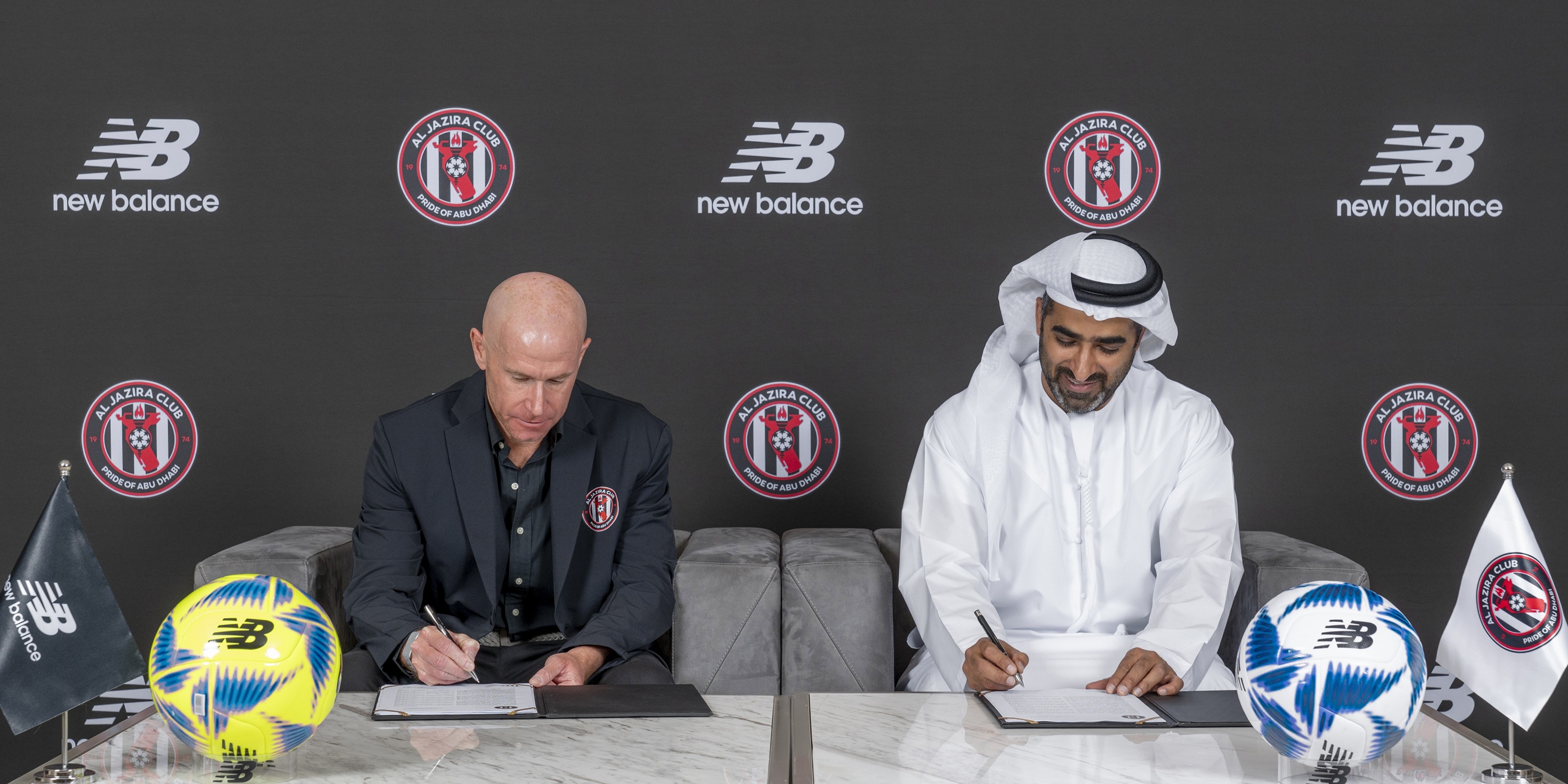
Abu Dhabi has a new look on the way. Al Jazira Sports and Cultural Club, the side its supporters call the Pride of Abu Dhabi, has signed a three year strategic partnership with New Balance, handing the Boston sportswear brand responsibility for designing and supplying the club's official match, training and travel kits. The club announced the agreement on 8 August 2026, and Gulf News and Campaign Middle East carried the story two days later.
On paper it is a kit supplier deal. In practice it reaches much further than the first team shirt. According to the club, the agreement covers the first football team, the football academy and Al Jazira's other sports teams, which means the New Balance logo will be on show at the Mohammed bin Zayed Stadium on matchday, on the training pitches during the week and on the youngsters coming through the academy. Neither side put a figure on the deal in any of the announcements.
For anyone who follows sports sponsorship in the Gulf, the signing is a useful marker. A global brand with a clear football plan has chosen one of the UAE's most decorated clubs as its partner, and it has done so in a way that leans heavily on youth development and community rather than on a single star name. That combination says a great deal about where sports marketing in the region is heading.
The agreement was signed by Tariq Mohammed Al Muhairi, Chief Executive Officer of Al Jazira Club Group, and Stuart Henwood, Senior Director and General Manager of New Balance for the Middle East, Africa and India, a region the brand shortens to MEAI. Under the terms published by the club, New Balance will design and supply the official match kits along with training apparel and travel wear for the length of the three year term.
Al Muhairi framed the deal as a starting point rather than a simple supply contract. "We believe that this partnership with New Balance will mark the beginning of a new phase of strategic collaboration," he said in the club statement. He went on to explain the practical side: "This partnership will ensure that the needs of all teams are met in all local, regional, and international competitions," adding that the club's squads would be equipped "with the latest sportswear and footwear." He also made the scope explicit: "Our partnership will support the first football team, the academy, and the team sports teams at Al Jazira Club."
Gulf News reported that Al Muhairi gave three reasons for choosing New Balance: the brand's long experience in sport, its record of innovative products, and its investment in advanced technology and modern manufacturing. That last point is not a throwaway line. New Balance is one of the few major sportswear companies that still makes a meaningful share of its footwear in its own factories, and the club clearly saw that heritage as part of the appeal.
Henwood, for his part, spoke about values. "Al Jazira Club has an incredible legacy, an unwavering commitment to developing home-grown talent and a deep connection with its community, which are values that closely align with New Balance," he said. He placed the signing inside a wider regional push: "As we continue to grow our football presence across the Middle East, this partnership represents another important milestone." And he was clear that the brand sees the deal as an investment in the future of the game. "Through this partnership, we're not just supporting one of the UAE's most iconic clubs, we're helping enable and equip a new breed of grassroots movement, inspiring more young people to discover the game, develop their potential and pursue their passion."
Footwear Magazine, which covered the partnership in September, added that New Balance has introduced a campaign titled "A Love Letter to Abu Dhabi" to accompany the deal, tying the club's colours to the city and its supporters. It is a small detail, but it shows the brand intends to tell a story around the kit rather than simply print its logo on a shirt.
Kit supplier agreements are among the most visible sponsorships in football. A shirt sponsor buys space on the chest; a kit supplier shapes the entire visual identity of the club, from the collar and the trim to the training tops worn in warm ups and the tracksuits the players wear when they travel to away fixtures. Every photograph, every highlight clip and every replica jersey sold in a shop carries the supplier's design language. For a brand, that is sports branding at its most complete, and few assets build brand awareness as steadily.
The Al Jazira agreement is especially broad because it runs right through the club. The academy element matters most of all. Al Jazira has built its reputation on producing local players, and by dressing those young players from their first days in the system, New Balance becomes part of their development story. When an academy graduate later breaks into the first team or the national side, the brand that supplied his boots and training kit as a teenager has a genuine claim to that journey. That is a very different proposition from a short term shirt deal, and it is one reason youth focused partnerships are becoming popular across sports sponsorship in the Gulf.
There is also the multi sport angle. Al Jazira is a sports and cultural club, not only a football club, and the agreement extends to its other teams. That gives New Balance a presence across several disciplines and age groups under one badge, which helps it reach families and community players as well as matchday crowds.
Finally there is retail. Replica shirts, training wear and lifestyle apparel are where fans express their loyalty, and a three year term gives the brand time to build ranges, refresh designs each season and turn the partnership into a product line rather than a one season curiosity. For brands studying content marketing around sport, a kit launch is also a ready made content moment, with reveal videos, player shoots and fan campaigns that can run across social channels for weeks.
Al Jazira was founded in 1974 through the merger of two Abu Dhabi clubs, Khalidiyah and Al Bateen. Alongside the Pride of Abu Dhabi, the club also carries the nickname Al Ankabout, The Spider. Its home is the Mohammed bin Zayed Stadium in the capital, a ground The National describes as a 37,000 seat venue, making it one of the larger club stadiums in the country.
The club's modern era took shape after Sheikh Mansour invested in Al Jazira in the 2000s, a period linked to the most successful spell in its history. Al Jazira has won the UAE Pro League three times, in 2011, 2017 and 2021. It has lifted the UAE President's Cup three times, in the 2010/11, 2011/12 and 2015/16 seasons, won the League Cup in 2009/10 and again in 2024/25, claimed the UAE Super Cup in 2021 and won the GCC Champions League in 2007. It also holds two second tier titles from the 1980s.
The club's most famous international moment came in December 2017. As champions of the 2016/17 UAE Pro League, Al Jazira qualified for the FIFA Club World Cup as the host nation's representative and made its debut in the tournament. It beat Auckland City, with Romarinho scoring, and then Urawa Red Diamonds of Japan, with Ali Mabkhout getting the goal. That set up a semi final against Real Madrid on 13 December 2017 in front of 36,650 spectators. Romarinho scored for Al Jazira in the 41st minute, and although Real Madrid came through and went on to win the tournament, the night is still remembered in Abu Dhabi as one of the great evenings for Emirati club football. Al Jazira eventually finished fourth after losing the third place match to Pachuca.
Above all, Al Jazira is known for developing its own. Wikipedia's record of the club highlights Ali Mabkhout and Khalfan Mubarak among its best known players, and notes that many home grown players have gone on to represent the UAE national team. That is exactly the reputation Henwood pointed to when he spoke about the club's commitment to home grown talent, and it explains why the academy sits at the centre of the new agreement.
The kit itself has passed through several famous hands. According to The National, Adidas, Puma, Kappa and Nike have all supplied Al Jazira's kit since the 1970s. New Balance now joins that list, and it arrives at a moment when the club is competitive again.
The UAE's top division is known as the ADNOC Pro League for sponsorship reasons, and it is a 14 team competition. The 2025/26 season ran from 16 August 2025 to 16 May 2026 and was won by Al Ain, who collected 68 points and their 15th league title. Shabab Al Ahli finished second on 58 points and Al Wasl third on 48.
Al Jazira finished fourth with 44 points, a clear step forward from seventh place in 2024/25 and eighth in 2023/24. The club also reached the final of the President's Cup, where it finished as runner up, and the semi finals of the League Cup. Fourth place earned a spot in the preliminary stage of the AFC Champions League Elite, which gives the new kit a potential continental stage in its very first season. The club is now coached by Cosmin Olaroiu, who took charge in 2026.
That sporting context matters to any sponsor. A partnership signed with a club on the rise, with silverware as recent as the 2024/25 League Cup and an Asian campaign in view, offers more exposure and more emotional moments than one signed with a side drifting in mid table. It also shows how sports sponsorship in the UAE works in practice: the strongest deals pair a brand's long term ambition with a club that has momentum on the pitch and a clear identity off it.
New Balance also joins a strong commercial line up at Al Jazira. The club's own website lists Mubadala as its Elite Partner and ADNOC as Premier Partner, with the Abu Dhabi Exports Office as Platinum Partner and Alpha Dhabi Holding, Kanoo Energy and Bin Sulaiman Group among its Official Partners. Dolphin Energy, Manazel and Cryo Health Clinic appear as Official Supporters. New Balance sits in the Official Partner tier, the only global sportswear name in a roster otherwise built largely around Abu Dhabi institutions and regional companies.
New Balance is an unusual giant. Founded in 1906 in Boston as the New Balance Arch Support Company by William J. Riley, it is still privately held. The company says it employs around 14,000 associates worldwide and reported sales of 9.2 billion dollars in 2025. It runs five athletic footwear factories in New England and one in Flimby in the United Kingdom, which is why Al Muhairi's reference to modern manufacturing carries weight.
Its route into football has been gradual. The brand's subsidiary Warrior Sports began its soccer business in 2012, and New Balance announced its global entry into football under its own name in February 2015. The most high profile chapter was its time as Liverpool's kit supplier, which ended when Liverpool moved to Nike from January 2020. Rather than retreat, New Balance rebuilt its football portfolio club by club, often choosing teams with strong local identities and proud academies.
Today that portfolio reads like a carefully chosen map. FC Porto has worn New Balance since 2014 and LOSC Lille since 2016. Dynamo Kyiv, FC Tokyo, Deportivo Toluca, Auckland FC, São Paulo, Newcastle Jets, Grêmio and Bursaspor are also on the list. In 2025 the brand made two statement signings in Europe. Atalanta, the Bergamo club famous for its youth academy and winner of the UEFA Europa League in 2024, became a New Balance club from the 2025/26 season, and the two sides unveiled their second home kit together on 16 July 2026. Bayer Leverkusen followed, with SGI Europe reporting that New Balance replaced Castore from the start of 2025/26 on a multi year deal covering every team at the club, from junior boys and girls to the women's side and the men's professionals, along with joint campaigns and community activations.
Read alongside those deals, the Al Jazira signing fits a pattern. New Balance likes clubs with heritage, clubs that produce their own players and clubs whose supporters feel a strong sense of place. Atalanta and Leverkusen bring that in Europe. Porto and Lille bring it in Portugal and France. Al Jazira now brings it to the UAE.
Al Jazira is not New Balance's first step in the region. The brand is the official kit partner of Qatar's Al Sadd SC, a relationship SportBusiness reported began as a three year deal covering the 2022/23 to 2024/25 seasons. According to The National, New Balance also supplied Al Nassr's home and away kits for the 2017/18 season, years before Cristiano Ronaldo's arrival turned the Riyadh club into a global name. Beyond football, the brand partnered with the Doha Marathon by Ooredoo in 2025, a classic piece of event sponsorship, and its New Balance Run Club has communities in Riyadh, Doha, Abu Dhabi and Dubai.
That mix of football clubs, running events and community groups is a textbook example of 360 degree sports marketing. Instead of placing one large bet, the brand builds lots of touchpoints: elite teams for visibility, mass participation events for reach, and run clubs for daily contact with consumers. Each piece supports the others, and each helps the brand earn credibility with Gulf audiences who are increasingly active, increasingly fashion conscious and increasingly loyal to the teams on their doorstep.
The National put the wider trend neatly in a feature published shortly after the Al Jazira announcement. It described the GCC as one of sport's fastest growing markets, with governments investing in football, Formula One, golf, cycling and combat sports to diversify their economies and attract visitors, and it argued that sponsorship now gives brands an emotional connection that conventional advertising cannot match. In that reading, deals like this one work on two levels at once: global brands gain credibility in Gulf communities, and Gulf clubs gain reach and recognition from being associated with global names.
For marketers, the Al Jazira and New Balance agreement offers several lessons that apply well beyond sportswear. The first is that depth beats breadth. By covering the first team, the academy and the club's other sports, New Balance has bought a presence in every corner of the club's life. A bank, telecoms company or consumer brand looking at UAE football club sponsorship can borrow the same thinking, attaching its name to a youth programme, a women's team or a community initiative alongside the senior squad to build brand awareness that lasts longer than a single season.
The second lesson is about story. The "A Love Letter to Abu Dhabi" campaign shows that the strongest sponsorships give fans a reason to care. Linking a brand to a city's identity, its colours and its people turns a commercial arrangement into something supporters feel part of. That is where good activation, from kit launch films to player appearances and the right ambassador choices, makes the difference between a logo and a relationship.
The third lesson concerns timing. New Balance has arrived as Al Jazira returns to the top four, with an Asian campaign possible and a squad still built around the academy. Sponsors who move when a club is rising often get more value than those who arrive at the peak. For brands assessing sports sponsorship opportunities in Dubai and Abu Dhabi, that means watching league tables, youth pipelines and fan engagement as closely as headline audience numbers.
Finally, the deal is a reminder that sponsorships in the region now come in many shapes. Shirt deals, kit supplier agreements, stadium naming rights, event sponsorship around marathons and tournaments, and partnerships with individual athletes all have a place. The smartest programmes combine several of them, using sports branding on the pitch and storytelling off it, supported by digital campaigns that keep the conversation going between matches.
Over the next three seasons, Al Jazira's players, academy graduates and other teams will carry New Balance's designs across local, regional and possibly continental competitions. If the partnership delivers what both sides promised, it will strengthen the club's identity, give young players kit worthy of their ambitions and give New Balance a firm foothold in UAE football. For any business working out how to use sports marketing in the Emirates, it is a deal worth studying closely, and a good moment to speak with a specialist marketing agency in Dubai about where the next opportunity lies.
Sources: Al Jazira Club, Gulf News, Campaign Middle East, The National, Footwear Magazine, Dubai Standard, SportBusiness, SGI Europe, Atalanta BC, New Balance, Wikipedia