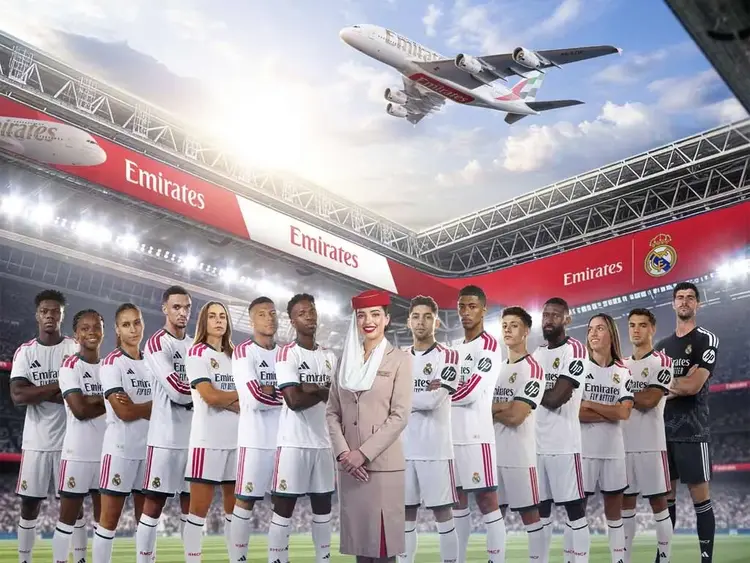
Few sponsorships in world football carry the same weight as the long running relationship between Emirates and Real Madrid. Their renewed agreement, extending the partnership to 2031, is not just another commercial renewal. It is a major statement about sports marketing, sports branding, and the long term power of event sponsorships in elite global sport.
The deal keeps Emirates as Real Madrid’s main sponsor across the men’s team, women’s team, basketball section, training wear, and staff apparel, while also turning the partnership into the longest running shirt sponsorship in LaLiga history.
Emirates first became a sponsor of Real Madrid in 2011 and moved into the main sponsor role in 2013, which means the relationship has now developed into one of the most recognizable examples of sustained sports sponsorship in modern football.
That continuity matters because it shows how premium sponsorship works when it is treated as a long term brand platform rather than a short term exposure buy. In sports marketing terms, the partnership has become part of Real Madrid’s identity and part of Emirates’ global brand architecture.
The new extension to 2031 reportedly raises the value of the deal to around 100 million euros per season, a figure described in multiple reports as record breaking for a shirt sponsorship in world football.
This is more than a logo on a shirt. It is a strategic sports branding play that links one of the world’s biggest clubs with one of the world’s most visible airlines, creating a commercial relationship that reaches far beyond matchday.
For Real Madrid, the renewal protects one of its most valuable revenue streams and reinforces the club’s position at the very top of global sports sponsorship. For Emirates, it preserves a premium association that reaches millions of fans across football, basketball, youth football, and international media coverage.
The deal also shows how event sponsorships at the highest level now function as global media assets. The shirt, the training kit, the broadcast image, and the social media footprint all work together to create a single commercial ecosystem.
Real Madrid gains stability, scale, and a premium partner that matches the club’s global ambition. The agreement reportedly covers the men’s and women’s teams, the basketball division, and youth teams, which broadens the commercial reach of the sponsorship far beyond the first team alone.
That multi team structure strengthens the club’s marketing strategy because it gives the sponsor far more inventory to activate. It also allows Real Madrid to present the partnership as a club wide alliance rather than a narrow shirt deal, which is far more compelling in today’s sports marketing environment.
From a financial perspective, the reported increase from the previous range of 70 million to 80 million euros per year to roughly 100 million euros per year is significant. It underscores how elite football sponsorship has become an arms race for brand value and commercial prestige.
For Emirates, the partnership is a major piece of global sports branding. The airline is not merely buying visibility, it is attaching itself to one of the most powerful cultural and commercial brands in sport.
That association gives Emirates long term premium positioning in a way that standard advertising cannot easily replicate. In sports marketing terms, the airline gains consistent exposure in stadiums, broadcasts, digital platforms, and fan conversations across multiple continents.
The renewal also reinforces Emirates’ reputation as one of the most active and sophisticated sponsors in sports sponsorship. Maintaining a relationship of this scale for nearly two decades is a signal of both financial strength and strategic discipline.
The commercial logic behind deals like this is simple but powerful. Top clubs want dependable, high value partners that can support growth over many seasons, while top global brands want association with excellence, winning culture, and international reach.
That is why this agreement is so useful as a case study in sports marketing. It is not driven by novelty. It is driven by consistency, reputation, and the ability to generate return through long horizon sports sponsorship rather than quick campaign bursts.
The renewal also demonstrates how premium sports branding now relies on cross platform presence. Emirates will continue to appear on kits, training apparel, and staff wear, which means the brand is embedded across the club’s day to day commercial image, not just its matchday presentation.
The announcement itself was a commercial event, but it also functioned as a brand moment. Real Madrid used the renewal to highlight the scale and longevity of the relationship, while the airline used the occasion to underline its global sports identity.
These kinds of announcements are increasingly important in modern event sponsorships because they generate their own media cycle. A renewal of this size is not just a contractual update, it is a story about continuity, ambition, and the value of elite sports partnerships.
For readers and fans, the event shows that sponsorship can be more than transactional. When executed well, it becomes part of the narrative of the club and part of the identity of the sponsor.
The scale of the Emirates and Real Madrid agreement makes it a reference point for the wider industry. It sets a benchmark for sports sponsorship pricing, for the depth of rights packages, and for the way brands think about long term sports marketing partnerships.
It also matters because it covers both football and basketball, showing that modern sports branding is increasingly multi property and not limited to one team or one competition. That approach maximizes visibility while reinforcing the idea that the sponsor is aligned with the entire club ecosystem.
In a crowded global market, that kind of integrated sponsorship is hard to beat. It combines prestige, continuity, scale, and relevance in a way that many brands want but few can secure.
The deal is likely to influence how other clubs and brands structure future renewals. When a partnership reaches this level of maturity and value, it becomes a model for how sports marketing can support brand equity over time rather than just visibility in the moment.
It also strengthens the commercial logic of premium event sponsorships. Major clubs and major brands increasingly want deals that are not only visible but strategically useful across multiple touchpoints, from broadcast to digital to merchandise and fan identity.
For Emirates and Real Madrid, the message is clear. This is not a short term sponsorship story. It is a long term alliance built on shared global ambition, commercial strength, and one of the strongest examples of sports branding in modern football.
Sources: Real Madrid, Emirates, SportsPro, OneFootball, UA News, Globo Esporte, Finance Football, Madrid Universal, KuCoin News.