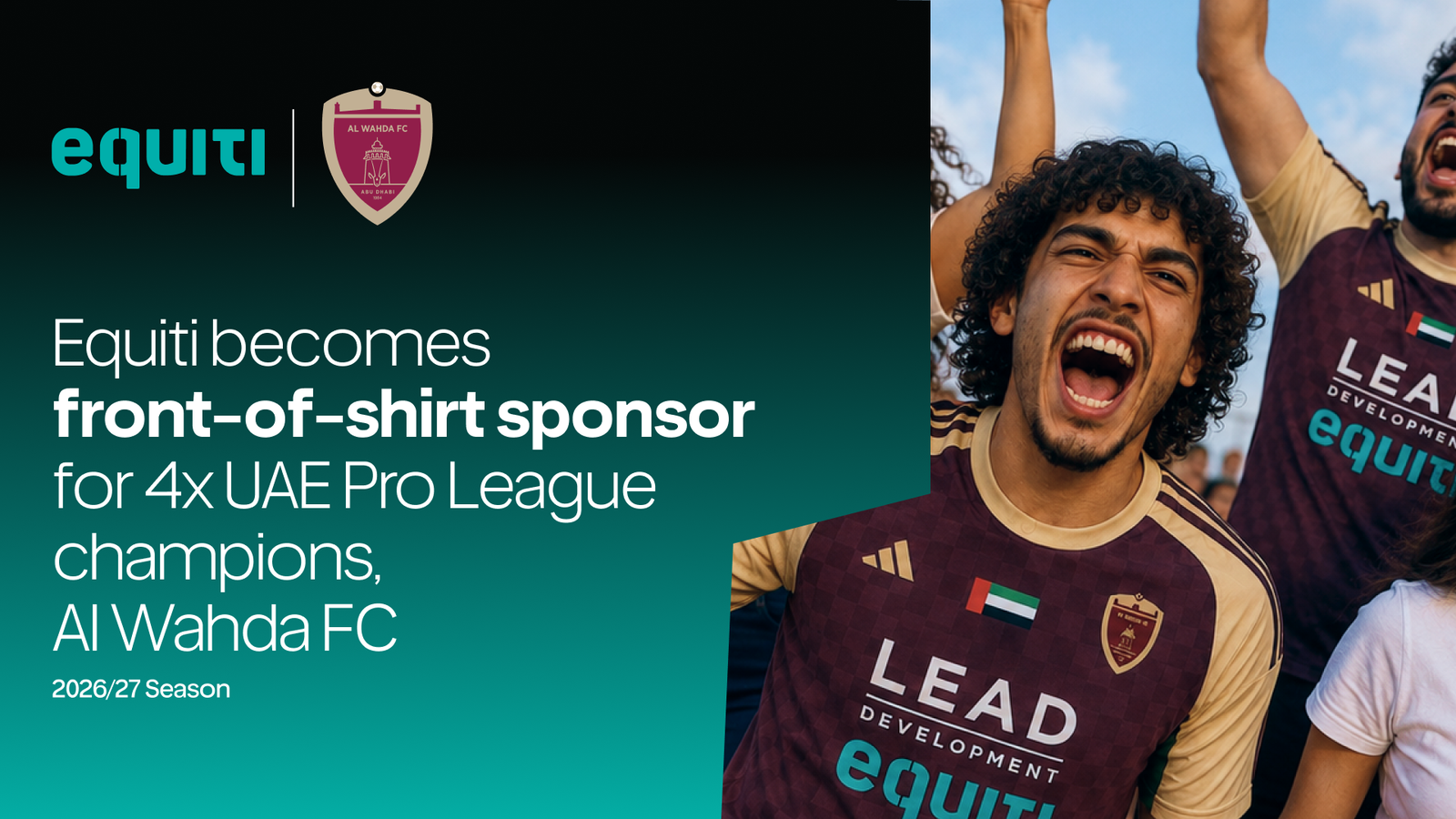
For two seasons, Equiti sat on the sleeve of Al Wahda FC. It was a respectable spot, visible to anyone watching closely, but it was never the first thing a fan noticed. That changed on 14 August 2026, when the UAE headquartered fintech group announced that it had renewed and expanded its deal with the Abu Dhabi club for the 2026/27 season. Its logo now moves to the front of Al Wahda's home, away and goalkeeper shirts, where it shares the space with Abu Dhabi property developer Lead Development.
The shirt is only the headline. According to the official Equiti announcement, the package also makes the company the exclusive training kit partner, adds a bundle of matchday rights at Al Nahyan Stadium, puts the Equiti name on a supporter entrance known as the Equiti Gate, and brings back the Equiti Challenge, a corporate football tournament staged at the club's home ground. Neither side has disclosed the value of the agreement or committed publicly to anything beyond the coming season.
It is a small story by the standards of European football, yet it says a lot about how UAE football club sponsorship is maturing. A brand that started on the sleeve has climbed, step by step, to the most valuable piece of real estate a club owns. For anyone thinking about sports sponsorship opportunities in Dubai and Abu Dhabi, the path Equiti has taken is worth studying closely.
The new agreement covers every competition Al Wahda plays in during 2026/27: the ADNOC Pro League, the UAE President's Cup, the ADIB Cup, the QAT UAE Challenge Cup and the Pro League U23 competition. Campaign Middle East and Zawya, which both carried the full release, list the stadium inventory in unusual detail. Equiti receives ten minutes of pitch side LED advertising on every matchday, three content windows on the giant screen (before kick off, at half time and after the final whistle), branding on the home and away dugouts and 3D carpet branding around the pitch. Static boards appear at three general admission gates as well as at the Equiti Gate itself, and the brand is present in the club store at Al Wahda Mall and in the official online shop.
The training kit rights may be the quietest part of the deal and one of the smartest. As Zawya's copy of the release puts it, exclusive branding on first team and academy training wear gives Equiti visibility all year round. Matchdays come and go, but training photographs, behind the scenes clips and academy content fill a club's social channels every single week. In practical terms that means the logo travels far beyond the ninety minutes of a matchday, which is exactly the kind of steady sports branding that builds brand awareness over a full season.
Al Wahda had already shown off its new strips a little earlier. Al Bayan reported on 5 August 2026 that the club unveiled its kits for 2026/27, a maroon first choice shirt and a white reserve shirt that continues the club's recent habit of wearing white away from home. The sponsorship announcement followed nine days later.
The shared front of shirt arrangement is worth a moment of attention. Lead Development, described in the coverage simply as an Abu Dhabi property developer, holds the other half of that space. Two partners on the front of a shirt is less common in Europe, where one main sponsor usually dominates, but it lets a club split its most valuable asset between two categories that do not compete with each other. Here a financial technology brand and a real estate brand sit side by side, both clearly rooted in the capital.
The quotes released with the deal lean heavily on community and longevity rather than on reach or return. "This is a club with real history in Abu Dhabi," said Chantelle Johnson, Chief Marketing Officer of Equiti Group. "Expanding our role here is about showing up for that community, not just for a season, but for what comes after it." She also tied the agreement to the company's brand platform: "Al Wahda FC embodies the aim higher spirit, and this expanded partnership lets us stand alongside the club, its players and its fans."
His Excellency Fares Maktoum Al Mazrouei, Chairman of the Board of Directors of the Al Wahda Football Club Company, framed the move as the natural next step in a relationship that has grown over time. "This partnership with Equiti is an extension of a long and fruitful relationship," he said, adding that "Equiti represents excellence in fintech and in making financial markets accessible." According to Campaign Middle East, he said the relationship had grown "from a valued sponsorship into a genuine strategic partnership", and he closed with a promise: "We look forward to continuing to grow and strengthen this partnership alongside our players and our fans."
Read together, the statements explain the logic of the upgrade. The sponsor wants to be seen as a long term local presence, not a passing advertiser. The club wants a partner that grows with it. Good sports marketing is often exactly that simple, even when the contract behind it runs to many pages.
Equiti did not arrive at the front of the shirt overnight. The company first announced its Al Wahda sponsorship on 15 August 2024, taking a sleeve position that came with on ground events and VIP experiences as well as kit branding. At the time, Equiti Group co founder and Chief Managing Director Mohammed AlAhmad Ketmawi said: "We are honoured to partner with a club that shares our commitment to excellence." Co founder and CEO Iskandar Najjar added: "A key part of our ethos at Equiti is partnering wisely and delivering excellence locally."
A year later, on 21 August 2025, FX News Group reported that Equiti was renewing the sleeve deal for the 2025/26 season, with its logo returning to the official kits. Now, in the third summer of the relationship, the brand has moved to the chest. The steady climb is a textbook example of how sponsorships can be built in stages. A brand tests the audience, learns how the club activates, gathers its own data and then commits more money and more visibility once the fit is proven.
The timing also matters. The upgrade follows a season in which Al Wahda lifted the ADIB Cup for the fourth time. The club reported a total broadcast audience of 70.1 million across 760 hours of dedicated TV coverage in 2025/26, along with a cumulative social media reach of 194.5 million. The Fintech Times rightly pointed out that these are figures reported by the club and not independently verified, but they give a sense of the scale a front of shirt partner is buying into. Winning silverware is the best possible argument a club can make when it asks a sponsor to step up.
One element of the package goes beyond logos entirely. The Equiti Challenge, a corporate tournament held at Al Nahyan Stadium under Al Wahda's Sponsors Support and Success Partners Initiative, returns for its third edition. The second edition took place on 15 February 2026 and brought together eight institutional teams. Campaign Middle East lists Abu Dhabi Police, the Judicial Department, Equiti Group, the Department of Municipalities and Transport, Abu Dhabi City Municipality and the Ministry of Justice among them.
That guest list is the point. A tournament like this is a form of event sponsorship, arguably the most personal kind, that puts a brand in the same room, and on the same pitch, as the public institutions of the emirate. It creates relationships that a perimeter board never could. For a regulated financial company that wants to be trusted in Abu Dhabi, playing football with government departments on the club's own grass is a rather elegant way of earning goodwill.
It also shows how modern sports branding works in the Gulf. The logo on the shirt draws attention, but the experiences around it, from VIP hospitality to corporate tournaments and fan engagement on the club app, are what turn attention into loyalty. Brands that treat a club deal as a media buy alone tend to get less from it than brands that treat it as a platform for real activity. The best sponsorships in the region combine sports branding with event sponsorship and hospitality, so that every touchpoint reinforces the others.
Al Wahda is one of the most decorated names in Emirati football. According to the club background published with the release, it was formed in 1984 through the merger of the Al Emarat and Abu Dhabi clubs, by decree of the late Sheikh Khalifa bin Zayed Al Nahyan. Sheikh Theyab bin Zayed Al Nahyan is the club's President.
The honours list is long. Al Wahda has won 19 major domestic trophies: four ADNOC Pro League titles, four ADIB Cups, four UAE Super Cups, three UAE FA Cups, two UAE President's Cups and two QAT UAE Challenge Cups. Those four league titles are why headlines describe the club as a four time UAE Pro League champion, a label Equiti was clearly happy to put in the title of its own announcement.
Home is Al Nahyan Stadium, inaugurated on 24 January 1995 and the club's ground ever since. It is also the stage for much of what Equiti has bought: the LED boards, the dugouts, the giant screen and the gates. A club with three decades in the same stadium, a loyal local following and a mall store that carries its name offers a sponsor something that is hard to buy elsewhere, a sense of belonging to the city.
For brands weighing Abu Dhabi football sponsorship, that heritage carries real weight. Supporters notice which companies stand by their club over several seasons, and they tend to reward that loyalty. A sponsor that moves up the shirt after two years sends a message that it is staying, which is exactly what Chantelle Johnson's comments were designed to convey.
Equiti's move is part of a broader pattern. Trading platforms and payment companies have become some of the most active sponsors in UAE sport, and the reasons are not hard to find. The Fintech Times noted that Gulf regulators, including the DFSA in Dubai and ADGM in Abu Dhabi, attract internationally licensed fintech firms, and that other trading and payments groups have also pursued regional sports deals. A licence in the UAE gives a company a reason to build brand awareness locally, and sport is the fastest route to a broad and engaged audience.
The league itself has courted the sector for years. The UAE Pro League announced on 14 October 2024 that it had renewed and extended its partnership with online trading broker AvaTrade for the 2024/25 season, keeping the company among the main partners of the ADNOC Pro League. The league linked the deal to its 2020 to 2030 strategic plan and said it would work with AvaTrade to raise awareness of online trading among professional clubs and promote safe investment. Fadi Abou Ras, CEO of Ava Trade Middle East Limited, said at the time: "We are thrilled to have extended our strategic partnership with the UAE Pro League."
Other brokers have looked for different entry points. Trade Informer reported in May 2025 that NAGA would be the main official sponsor of the UAE national minifootball team at the WMF World Cup in Baku, with its branding on the front of the players' shirts. The same report noted that the Middle East generated almost 40 percent of NAGA's group revenue in 2024.
Financial brands in Emirati football are not entirely new, of course. Khaleej Times reported back in September 2010 that Barclays had signed a two year deal as the exclusive financial services sponsor of Al Jazira, including naming rights to two towers at Mohammed bin Zayed Stadium. What has changed is the type of company involved. Where a global bank once led the way, today it is digital brokers and fintech groups competing for shirts, boards and naming rights.
Al Wahda is the centrepiece of a sports portfolio that has expanded quickly. In June 2025, Finance Magnates reported that Equiti had become naming partner of Dubai's Youth Football League, renamed the Equiti Youth Football League, with more than 400 teams and over 4,500 registered players. In September 2025 the company signed as founding partner of Dubai Basketball for three seasons, ahead of the club's EuroLeague debut, with its branding on the team's official jerseys and courtside at Coca-Cola Arena. And in May 2026, Finance Magnates reported a three year deal between Equiti's Jordan unit and the Jordan Tennis Federation, running until April 2029.
The sponsorship strategy runs alongside a physical expansion in the Emirates. Finance Magnates reported on 23 September 2026 that Equiti had opened a walk in branch in Al Ain, its second storefront in the country after one opened earlier that month on King Faisal Road in Sharjah. Both operate under Equiti Securities Currencies Brokers, licensed by the UAE's Capital Market Authority. The company's Abu Dhabi office opened in 2023. Put those facts next to each other and the logic becomes clear. Equiti is building a retail presence across the country, and it is using football and basketball to make its name familiar to the people walking past those branches.
That combination of sponsorship, digital advertising on club channels and real world presence is close to what agencies call 360 marketing. The shirt creates recognition, the club app and social channels keep the conversation going, and the branches and corporate events give people somewhere to act on what they have seen. It is a model that any brand with a long term commitment to the UAE could borrow, and it shows how sports marketing and brand awareness work best when they feed each other.
There are several lessons here for companies exploring sports sponsorship in the Emirates. The first is that the sleeve can be a very effective starting point. It is a lower cost way to get to know a club, test activation ideas and build internal confidence before a bigger commitment. Equiti used two seasons on the sleeve to prove the relationship, then moved up.
The second is that shared front of shirt deals open the door to brands that might not be able to afford a club's entire chest. Al Wahda has split that space between fintech and real estate, which suggests clubs in the region are willing to package their inventory creatively when the categories sit comfortably together.
The third is that value lives in the details. Ten minutes of LED time, three giant screen windows, a named gate, training wear and a corporate tournament each serve a different purpose. Some deliver reach, some deliver content and some deliver relationships. The strongest UAE football club sponsorship packages blend all three, and a smart partner measures each one rather than judging the deal on shirt exposure alone.
Finally, financial services brands in particular should pay attention to the tone of the announcements. Neither Equiti nor Al Wahda talked about trading products or promotions. They talked about history, community and shared ambition. In a region where trust and regulation matter enormously, that restraint is part of good sports marketing rather than a lack of it.
For brands that want to follow a similar path, working with an experienced marketing agency in Dubai can make the difference between a logo on a shirt and a partnership that genuinely moves the business. TRIX20 helps companies find the right sports sponsorship opportunities across the UAE and builds the digital advertising and content plans that bring those deals to life. As Equiti's journey from sleeve to shirt front shows, the clubs are ready to grow with partners who are willing to commit.
Sources: Equiti, Finance Magnates, Campaign Middle East, The Fintech Times, Zawya, FX News Group, Al Bayan, UAE Pro League, Trade Informer, Khaleej Times, PR Newswire