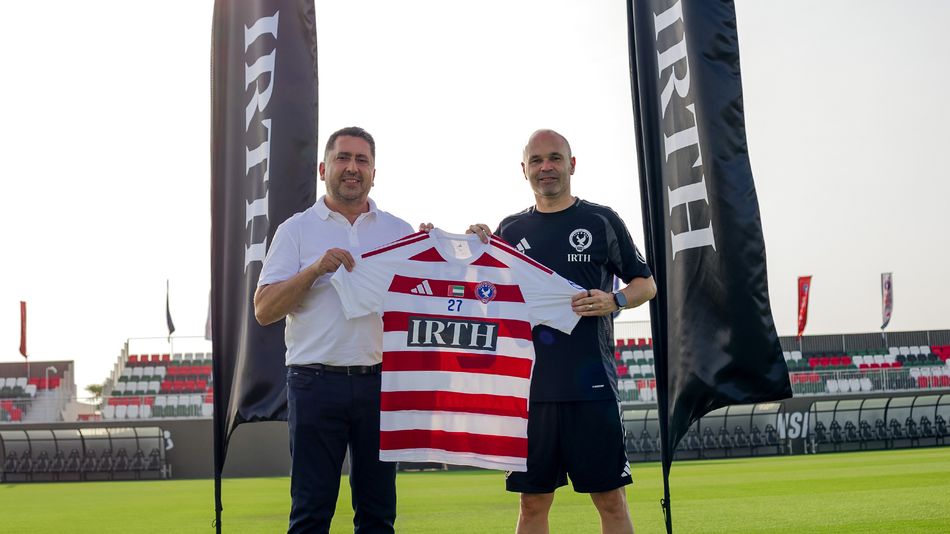
Two weeks, two brands, one shirt that suddenly carries a lot more weight. Gulf United FC, the Dubai club playing in the UAE First Division, has signed real estate developer IRTH Group as its Principal Sponsor and Official Front-of-Shirt Partner for the 2026/27 season. The announcement, published on Zawya on 10 September 2026, arrives barely a fortnight after consumer electronics giant TCL revealed its own partnership with the club, built around fan engagement, football content and storytelling.
Together, the deals say something bigger than either one alone. Gulf United is the club where Andrés Iniesta, the Barcelona and Spain great who scored the winning goal in the 2010 World Cup final, has taken his first job as a head coach. A club that started life as a youth academy in 2019 now has a global consumer brand and an ambitious local developer queuing up to stand beside it.
For anyone working in sports marketing in the Gulf, the timing is worth studying. The two agreements are very different in shape. One puts a name across the chest of every player from the first team down to the youngest academy group. The other is about content, screens and the stories that live around the matchday. Both, however, are buying into the same idea: a young, community minded Dubai club that now has one of the most recognisable faces in world football on its touchline.
The IRTH agreement is the headline act. According to the press release distributed through Zawya, IRTH Group becomes Gulf United's Principal Sponsor and Official Front-of-Shirt Partner for the 2026/27 season. Its branding will appear on the shirts of the professional First Team and on the shirts of the academy teams across all age groups. That detail matters, because it puts the brand on hundreds of young players and in front of the families who gather around youth football in Dubai every week.
The partnership goes beyond a logo. The two organisations say they will collaborate on content, activations and community initiatives throughout the season, with a programme designed to bring together players, families, supporters and the wider Dubai community. No financial terms were disclosed, and the release does not say whether the agreement could run beyond the coming campaign.
IRTH describes itself as a UAE born real estate development company that creates spaces shaped around people and the way they live, work and connect. Its philosophy is summed up in the phrase "Legacy in Motion", the idea that a legacy is built continuously and carried forward rather than finished. Gulf Business has previously reported that the company was founded by the Alshamsi family and that the name IRTH comes from an Arabic word linked to past, present and future.
Osman Çeliker, CEO of IRTH Group, framed the deal as a meeting of two homegrown stories. "We are incredibly excited to begin this journey with Gulf United Football Club," he said. "There is something very natural about our coming together." He pointed to shared roots: "IRTH and Gulf United were both born in the UAE, both put people at the centre of what they do." He also spoke about the club's growth, saying: "To see Gulf United begin as an academy and evolve into the organisation it is today is remarkable."
Çeliker's comments went further than the usual sponsor language. "I have always believed that football is more than football," he said. "It teaches you how to win and, just as importantly, how to lose, learn, stand up and go again." And on legacy: "If what we build together can positively influence people's lives and create something meaningful for the generations coming after us, then that is a legacy worth building."
Club president Ahmed El Saraf described the agreement as "two organisations born and rooted in Dubai" coming together, adding: "We are proud to welcome IRTH Group as our main sponsor." Iniesta himself added his voice to the release. "We're happy to partner with IRTH, a home-grown property developer with such a great reputation," the head coach said. "We share the same passion for engaging with the community and giving opportunities to those within it."
The TCL deal came first. The company announced its partnership with Gulf United in a release dated 25 August 2026, and Campaign Middle East reported it the following day, 26 August. TCL describes itself as a leading consumer electronics brand and a leader in the global television industry, operating in more than 160 markets. It calls itself the world's number one Mini LED TV brand.
Rather than a shirt placement, the TCL agreement is built around fan engagement, football focused content and storytelling. The goal, according to the announcement, is to bring supporters closer to the club, its players and the team's wider journey through the season. Neither the length of the deal nor its value was made public. Campaign Middle East presented the agreement as part of TCL's expanding sports presence in the Middle East.
That presence is already substantial. TCL's football portfolio includes Arsenal Football Club and the Spanish national football team, and the company is also involved with the Olympic movement and other international sporting platforms. The link with Gulf United is not random. Iniesta is one of the most celebrated players in the history of the Spanish national team, and TCL has built its football story partly around Spain. Adding the club where he is beginning his coaching life is a natural extension of that narrative.
The deal is tied to TCL's "Inspire Greatness" philosophy. Vic Shen, General Manager of TCL Middle East, explained: "At TCL, Inspire Greatness is about recognising potential and helping create the opportunities for it to grow." He continued: "Gulf United represents that mindset very clearly. It is a club with ambition, a strong belief in young talent and now the experience and leadership of Andrés Iniesta guiding its next chapter. We are proud to support that journey."
Majid Khan Niazi, Director of Marketing for TCL Middle East and Africa, made the case for sport as a platform. "Sport creates connections in a way very few platforms can," he said. "For TCL, our investment in sport is about being part of the moments and stories that inspire people." On the club itself, he added that Gulf United "is building something with a clear sense of purpose, particularly through its commitment to giving talented young players a pathway to progress," and said the company sees "significant potential in what we can build together."
Speaking at the club's press conference in Dubai, Iniesta gave the youth message his own spin. "Gulf United is a club that believes in youth," he said. "Players are not given opportunities just because they are young, but because they possess quality." He also set the tone for his squad: "I always have high expectations, and our goal is to be the best, and this process happens on a day to day basis."
Put side by side, the agreements show two clear ways a brand can approach UAE football club sponsorship. IRTH has chosen the classic route of sports branding: the most visible spot on the kit, a principal partner title and a presence that runs from the senior team to the smallest academy player. That is a play for recognition, for being the name that people associate with the club every time they see a photo, a highlight or a child wearing the shirt in a Dubai park.
TCL has gone the other way. Its deal is about what happens around the football rather than on the shirt. Fan engagement, storytelling and football focused content are the language of content marketing, where the value is created by the material a brand helps to produce and distribute. For a company that sells screens, a partnership measured in stories and moments makes obvious sense.
Both approaches fit naturally on the same club because they do not compete for the same asset. One partner owns the chest, the other owns the narrative. It is a useful reminder that strong sports sponsorship is rarely about a single placement. The best sponsorships start from a clear objective. For IRTH, that objective appears to be brand awareness and community connection in its home city. For TCL, it is about stories that support a global brand message and connect the company to a coach whose name travels well beyond the UAE.
There is also a common thread. Both brands chose Gulf United for its youth focus: IRTH talks about community, families and opportunity, TCL about potential and a pathway to progress. That consistency is what makes the club attractive, because sponsors know exactly what story they are buying into.
Gulf United's own story explains much of that appeal. The club was founded in Dubai in 2019 as a football academy for young players. Gulf News reports that it was originally established by football coaches from Manchester and that it is known as "The People's Club". It entered the UAE football pyramid in 2021, won the Third Division in its debut season and then earned back to back promotions to reach the UAE First Division, the second tier of the national game.
When Volkswagen Middle East became a partner in early 2024, the announcement described Gulf United as the UAE's first team to achieve back to back promotions and league titles. That earlier deal launched the first Volkswagen Cup, a grassroots tournament for boys and girls aged 4 to 12, with 32 teams competing at Kings School Al Barsha in March 2024, according to Motory. Matthias Ziegler, Managing Director of Volkswagen Middle East, summed it up at the time with a neat line: "Our partnership with Gulf United FC brings the people's club together with the people's car."
The club's scale is unusual for its level. According to Gulf News, Gulf United has more than 600 players representing 83 nationalities, and it fields the youngest squad in the First Division. It runs a youth academy and scholarship programmes, and it has built a reputation for giving former professional players their first coaching roles. The Zawya release on the IRTH deal describes the result as a clear player development pathway from academy level to professional football.
That model is the core of the commercial pitch. In a city where many families are expatriates and football is a shared language, a club with dozens of nationalities in its ranks speaks to a very broad audience. A sponsor on the shirt reaches supporters in the stands, but also parents on the touchline at academy sessions and the wider Dubai community the club has grown up with.
The other reason both brands are paying attention is the man in the dugout. Gulf United announced Andrés Iniesta as its new head coach on 1 June 2026, succeeding Ahmet Cebe ahead of the 2026/27 season, as reported by Gulf News. Reuters and the Associated Press both reported the appointment as his first coaching job. The club said that, having obtained his UEFA A Licence, Iniesta joins as head coach while he continues working towards his Pro Licence.
With Barcelona he won four UEFA Champions League titles and nine La Liga trophies, as noted by The National. With Spain he earned 131 caps, according to Gulf News, and scored the extra time winner against the Netherlands in the 2010 World Cup final. Later in his career he played in Japan and then in the UAE, spending his final season as a player at Emirates Club before retiring in 2024, according to the Associated Press.
Iniesta is also a Dubai resident. In an interview with The National, published after his unveiling at the club in August, he explained that the move was easy for his family. "We have been living here for three years," he said. For brands, a star who lives in the city is far more accessible than one who flies in for a single campaign shoot.
His public comments have stayed close to the club's identity. "Joining Gulf United FC feels like the right place to begin this new chapter," he said when the appointment was announced. "Football has given me everything, and now I want to give something back through coaching." In the Associated Press report, he added: "I believe in developing footballers the right way: with patience, with a clear idea of how the game should be played."
On paper, the UAE First Division is not where you would expect to find a global electronics company and a high profile developer signing up within a few weeks of each other. The biggest club sponsorship headlines in the country usually come from the ADNOC Pro League, one level higher. So why Gulf United, and why now?
The first answer is attention. Iniesta's appointment drew coverage from Reuters, the Associated Press, Gulf News and The National, and it was picked up by football media around the world. A second tier club rarely enjoys that kind of visibility, and Iniesta's name multiplies the audience far beyond the usual reach of the league. For a coach in his first job, his profile works almost like that of a club ambassador, lifting every message the club and its partners put out.
The second answer is story. In modern sports marketing, sponsors increasingly want a narrative, not just a logo position. Gulf United offers several at once: a club founded as an academy, a record breaking climb through the divisions, a squad of many nationalities, and now a world champion learning a new trade in front of young players. TCL's focus on storytelling and IRTH's emphasis on activations and community initiatives both reflect this.
The third answer is value. Entry costs at second tier level are generally lower than in the top flight, while the chance of growth is higher. A partner who joins early can grow with the club and, if results follow, be part of a promotion story.
For companies exploring sports sponsorship opportunities in Dubai, Gulf United's two signings offer a practical lesson. The most interesting deals are not always at the top of the league table. A club with a clear identity, a strong community base and a recognisable figure at its centre can deliver brand awareness and goodwill at a cost that top flight sponsorships rarely match.
The deals also show that there is room for several partners on one club, as long as each one owns something distinct. IRTH holds the shirt and the principal partner title. TCL holds the content and fan engagement space. Volkswagen Middle East, which joined in 2024, built its partnership around a grassroots tournament. That is how smart sports sponsorship portfolios are put together, whether the club plays in front of a few hundred people or a full stadium.
Activation is the other lesson. A shirt logo on its own can be quiet. The value comes from the content, community programmes and event sponsorship moments a brand builds around it, and both partners have signalled that they intend to do more than appear on a kit. Good sports branding is earned week by week, not printed once.
For brands that want to explore similar opportunities, working with an experienced marketing agency in Dubai can help to find the right club, the right asset and the right story. The most valuable partnerships often come from spotting momentum before everyone else does.
Gulf United now heads into the 2026/27 First Division campaign with a World Cup winner in charge, a new principal partner on the front of the shirt and a global electronics brand helping to tell its story. For a club that was a youth academy only seven years ago, that is a remarkable position to be in.
The on pitch test is still to come. Iniesta has spoken about high expectations and a winning mentality, and he has been honest that he is still learning his new role. Results will shape how far the commercial momentum can carry. In a city that wants to be a global sports capital, a club built on youth, diversity and community has found a formula that brands understand.
If a second tier club in Dubai can sign two partners of this calibre in little more than two weeks, where else is that kind of value hiding? Anyone who works in sports marketing in the region should be watching Gulf United's season just as closely as the fans.
Sources: Zawya, Campaign Middle East, Gulf News, The National, Reuters, Associated Press, Gulf Business, Motory