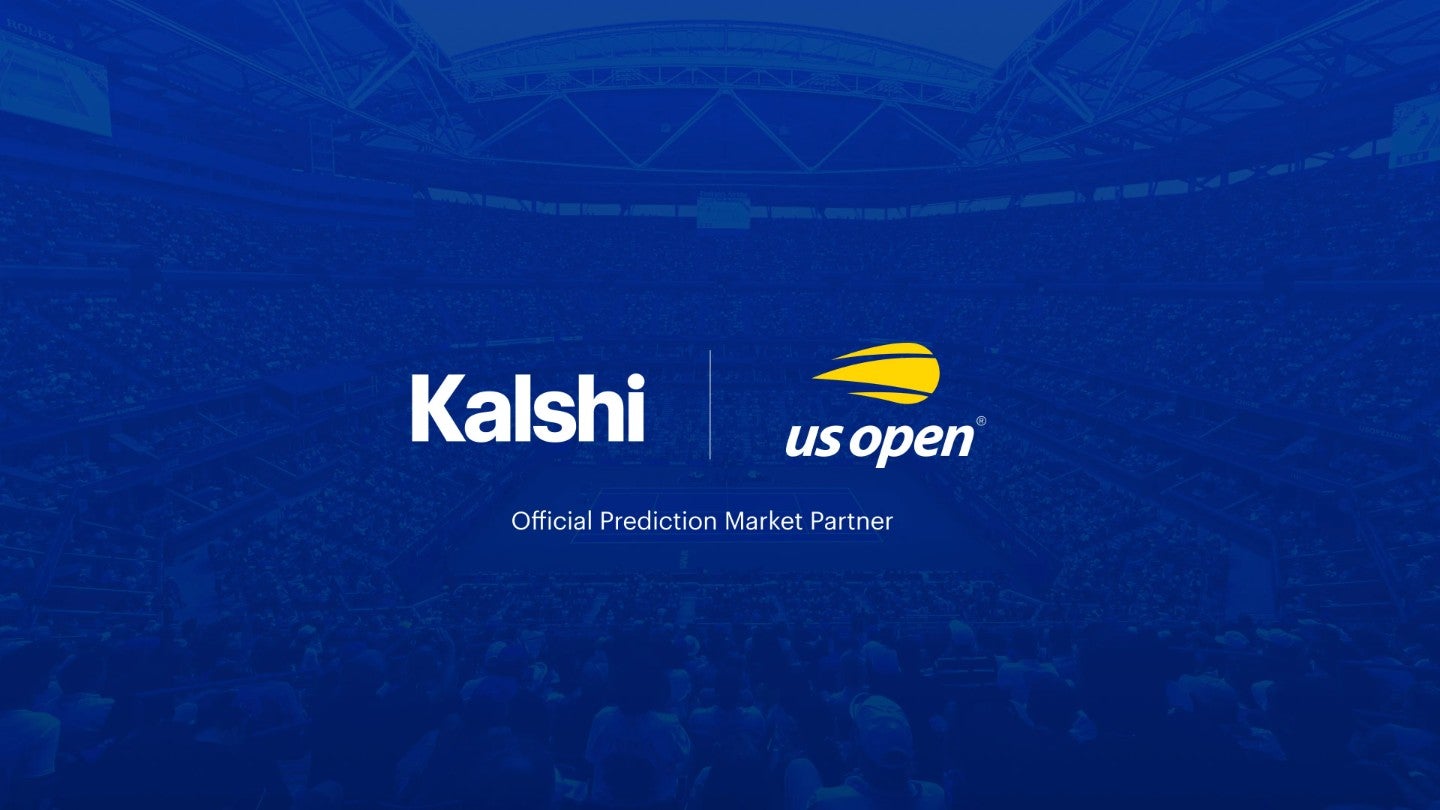
On Monday 31 August 2026, the United States Tennis Association named Kalshi the Official Prediction Market Partner of the US Open. The multi-year agreement began with the 2026 singles main draw at Flushing Meadows and puts the New York exchange on court signage, on screens around the grounds and across the tournament's digital platforms. Kalshi called itself the first-ever prediction market partner of the US Open, and its own announcement described the role as exclusive. Neither side disclosed what the deal is worth.
The news actually broke a day earlier. On Sunday 30 August, Front Office Sports reported, citing two sources, that the contract had only been finalised after the qualifying rounds the week before, and The Block picked up the report that same afternoon. The USTA confirmed it on Monday. According to Front Office Sports, rival prediction market platforms are barred from advertising at the venue and on ESPN's broadcasts of the tournament, a level of category protection one source described as "unusual".
What makes this more than another sponsorship announcement is the paperwork that came with it. Kalshi and the USTA agreed an integrity framework that keeps markets on umpire decisions, injuries and code violations off the platform, and Kalshi signed a confidential data sharing agreement with the International Tennis Integrity Agency for real-time surveillance of trading. Premium inventory, full category exclusivity and written integrity rules in one package: for anyone working in iGaming, Sports Betting or brand partnerships, that combination is the real story. It also holds lessons far from New York, including for the young regulated market in the UAE.
The visible part of the deal is familiar. Kalshi's name appears on court and across the tournament's digital channels, as Sports Video Group and Sportcal both reported from the USTA announcement. Kalshi's own announcement on its news site went further. The company said it will bring its real-time market data into US Open coverage, from previews and draw breakdowns to round recaps and daily highlights. Kalshi users are promised exclusive experiences, including behind-the-scenes access, on-court sessions with tennis legends and opportunities to meet players, plus premium hospitality at the biggest sessions, the semifinals and finals among them. Kalshi also plans activations on the ground at the Billie Jean King National Tennis Center and original content shot at the venue, and it said these experiences will grow in 2027 and beyond.
Both chief executives framed the partnership around innovation and trust. "We're relentless about keeping tennis at the cutting edge of global sports innovation and fan connection," said USTA CEO Craig Tiley, according to Sportcal. "Partnering with Kalshi gives us an opportunity to pioneer that next generation of fan engagement while ensuring the integrity of our sport," he added, as quoted by Covers and SBC Americas.
Kalshi co-founder and CEO Tarek Mansour leaned on geography and growth. "Every summer the US Open takes over New York, and as a New York company, we're proud to be part of it," he said. "Tennis is one of the fastest-growing sports on Kalshi, with fans using our markets to understand what's happening throughout the tournament." Kalshi said its tennis trading volume is up 25 times year on year, a figure several outlets, including Sports Video Group and Sports Betting Dime, carried from the company's announcement. It is Kalshi's own number and was not independently checked.
Seen purely as event sponsorship, this is a prized asset. Covers describes the US Open as the largest tennis event in the world, drawing 1.14 million fans, and the only Grand Slam played in the United States. Sportcal reported a 2026 prize fund of 108 million dollars, the biggest in tennis history and 20 percent up on 2025, with each singles champion taking home 5.5 million dollars and first round losers receiving 140,000 dollars. Kalshi joins a commercial roster that, according to Sportcal, also welcomed AT&T and Peloton ahead of this year's edition.
The speed of the agreement surprised the industry. According to Front Office Sports, the USTA had not planned a prediction market deal for 2026. It had held talks with several platforms, focused on match integrity and on partnerships from 2027 onwards, and as of the previous week it had not formally approved prediction markets as a sponsorship category. Crowdfund Insider, summarising the same reporting, noted that organisers had earlier cited questions around match integrity among the reasons for a cautious approach.
Sources credited Craig Tiley with moving the timeline forward. Tiley spent more than a decade running Tennis Australia and the Australian Open before taking the top job at the USTA this year. The rollout showed the haste. When play began on Sunday, Kalshi was not yet on the tournament's published list of official partners, and a Kalshi preview of the women's draw still carried the line "Kalshi is not affiliated with the U.S. Open or WTA." Front Office Sports reported that about 1.5 million dollars had already been traded on the women's singles winner market by Sunday afternoon.
There is history here too. As tennis writer Ben Rothenberg recalled in his Bounces newsletter, the Australian Open became the first Grand Slam to take an official betting sponsor in 2016, with William Hill, in a year shaken by betting scandals. That sponsorship did not come back the following year, and the Slams then stayed away from betting partners for close to a decade. The US Open deal ends that long pause, but through a company that insists it is not a betting operator at all.
The integrity section is the part of this deal that rights holders elsewhere will study most closely. Under the framework, Kalshi will not list markets tied to umpire decisions, player injuries or code violations. RotoWire described these as "subjective, in-match calls" that could create the wrong incentives, and noted that the structure looked more formal than a typical sponsorship rollout. Kalshi said it would work with the USTA and the International Tennis Integrity Agency to develop standards written specifically for prediction markets, rather than borrowing frameworks built for other industries, covering data sharing, education and market surveillance.
The ITIA is the independent body responsible for protecting professional tennis. SGI Europe pointed out that it was founded in 2021 by the ATP, the WTA, the ITF and the four Grand Slams, succeeding the Tennis Integrity Unit that operated from 2008 to 2020. Under Kalshi's data sharing agreement, trading activity on the exchange is visible to the ITIA so unusual patterns can be spotted and dealt with quickly. Mansour summed up the ambition in one line: "That's the standard for how leagues and prediction markets should partner."
Not everyone is convinced the framework settles the question. According to Rothenberg, the ITIA said commercial deals sit outside its remit, although it is monitoring the risks that prediction markets bring. RotoWire compared the approach to the compliance models major leagues built as legal Sports Betting spread across the United States, and argued that prediction market operators are now being held to a similar standard. That comparison matters. If exchanges accept the same surveillance, data and education duties as licensed bookmakers, the practical gap between the two models narrows, even while the legal gap stays wide.
The loudest pushback came from inside tennis. Rothenberg titled his piece "The U.S. Open is a Casino Now" and argued that Kalshi works in practice as a sports betting service, since it takes positions on who wins matches whatever the label says. He pointed to the money involved. A first round match between Flavio Cobolli and Francisco Comesana drew roughly 21.7 million dollars in trading volume, close to four times the 5.5 million dollar prize for the singles champion. Lower level Challenger and Futures matches also attracted trading, even where the prize money gap between rounds was tiny. Rothenberg stressed that he had no evidence any player had been approached, but argued that thin earnings at those levels create obvious temptations.
Players voiced their own discomfort. Rothenberg reported that Clara Tauson was surprised by the deal, that Alejandro Tabilo highlighted the double standard between strict player rules and tournament sponsorships, and that Linda Noskova said she felt powerless and expected more abusive messages. Players are barred from appearing in betting advertising, Rothenberg noted, yet tournaments face no equivalent restriction. SGI Europe cited Matteo Berrettini, speaking to UbiTennis, who said he had "received messages on his phone containing threats against my family and things like that" and called for "a stronger framework". Sports Illustrated writer Jon Wertheim asked on X how a tournament could "take sponsorship $ from a platform predicated on profiting from inside information?", according to SGI Europe.
The US Open is the latest and most prestigious step in a fast campaign by prediction markets to buy official status in sport. Tennis has been a particular focus. On 4 August, Axios reported that Polymarket had become the official prediction market platform of the ATP Tour and ATP Challenger Tour, covering around 20,000 matches a season, with exclusive streaming in the US prediction market category supplied through Tennis Data Innovations, the ATP's media and data arm. Covers reported that Kalshi signed a deal with Catalist Sports earlier in August for livestreams and data from more than 65,000 tennis matches.
The data layer underneath these deals is just as important. SGI Europe noted that Sportradar acquired IMG Arena in late 2025, bringing the data and audiovisual betting rights for the US Open, Wimbledon and Roland-Garros under its roof, and that Kalshi signed a global infrastructure deal with Sportradar in June 2026. SBC Americas added that both Kalshi and Polymarket hold official data agreements with Genius Sports and Sportradar. In other words, the same official data that powers licensed sportsbooks now also powers the exchanges that compete with them.
Beyond tennis, Kalshi and Polymarket are both official partners of the NHL, and Kalshi has also signed multi-year deals with five MLB clubs while Polymarket works with MLB and the New York Yankees. The money behind this push is large. The Block calculated that Kalshi, Polymarket and Polymarket US generated a combined 41.2 billion dollars in trading volume in August up to the date of its report, with Kalshi alone accounting for 33.7 billion dollars. Covers reported that sports make up roughly 80 percent of Kalshi's trading.
The awkward backdrop is that Kalshi signed a flagship New York partnership while the State of New York was suing it. On 31 July 2026, Attorney General Letitia James filed suit claiming that Kalshi runs an illegal gambling operation without a licence from the New York State Gaming Commission. The Block reported that the state seeks at least 36 billion dollars in compensatory damages, restitution, disgorgement and penalties. "No matter what they call themselves, prediction markets like Kalshi are gambling platforms, plain and simple," James said. Kalshi rejected the claim, telling Sportcal: "It's flat-out wrong to say that Kalshi is 'indistinguishable from traditional sports betting.'"
The legal argument comes down to who regulates event contracts. Kalshi and its rivals say their products are derivatives overseen at federal level by the Commodity Futures Trading Commission, so state gambling licences do not apply. States counter that a contract on who wins a tennis match is a bet. Sportcal noted that New Jersey, Tennessee and Ohio have brought similar claims. The courts are split. The Block reported that on Friday 28 August, just before the US Open deal surfaced, the Ninth Circuit ruled that Kalshi had not shown federal law overrides Nevada's gaming rules for its sports contracts, a result that conflicts with an earlier Third Circuit ruling that stopped New Jersey from regulating them.
For licensed Online Gambling operators, this is the heart of the matter. A state licensed sportsbook pays taxes, follows state advertising codes and checks the age and location of every customer. A prediction market argues that none of that applies to it, yet it now sits in the same commercial seat at a Grand Slam that a bookmaker might once have wanted. Front Office Sports noted that, as of the opening Sunday, no traditional sportsbook was listed among the US Open's official partners either. Until the courts or Congress settle the question, rights holders are effectively choosing which regulatory theory they are comfortable standing next to.
The first lesson is that integrity has become part of the product being sold. The USTA did not simply sell a category; it sold a category wrapped in market restrictions, a data sharing deal with the sport's integrity body and a promise of education. Any Online Gambling or Casino brand pitching a premium event in future should expect the rights holder to ask for the same, and should arrive with its own surveillance, data and responsible play plan already written rather than waiting to be asked.
The second lesson concerns category design. By creating a separate prediction market category and making it exclusive, the USTA opened a new revenue line without touching any betting inventory, and protected its partner by keeping rivals off the venue and the broadcast. Rights holders everywhere are slicing their inventory more finely, and brands need to read those category definitions with care. A clause about "betting" may not cover an exchange, and an exclusivity clause that ignores prediction markets may leave a sponsor exposed to a competitor on the same screens.
The third lesson is about activation. Kalshi is not only buying boards; it plans to feed live market prices into previews, recaps and highlights. That is content marketing built on data, and it turns the sponsor into part of how fans follow the event. Exchanges are now testing how far that can go when the rights holder is willing.
The fourth lesson is reputational. Player voices, as the reaction in Flushing Meadows showed, can shape the public story of a deal within days. Operators and brands that sign with tennis or any individual sport need a plan for abuse aimed at athletes and a clear position on what their markets will and will not cover. This is where good iGaming Consulting earns its place: mapping regulation, integrity duties and athlete sensitivities before a contract is signed, not after the backlash. For traditional sportsbooks, the message is that the competition for premium inventory now includes companies with a different legal model and a lot of money, and iGaming Consulting that only covers licensing is no longer enough.
The UAE is building its own regulated market from a very different starting point. In June 2026, Yogonet reported that the General Commercial Gaming Regulatory Authority had granted Play971, operated by Coin Technology Projects LLC of Abu Dhabi's Momentum Group, Internet Gaming and Sports Wagering licences, making it the first and at the time only Online Gambling brand authorised by the regulator. The platform offers sports betting, Casino games such as slots, blackjack and roulette, and live dealer tables streamed from a licensed studio in Abu Dhabi, all limited to customers aged 21 and over. The GCGRA has said it will take a strict line against unlicensed offshore operators targeting UAE consumers.
That structure, with one licensed brand and an active regulator, makes the US Open model instructive. In the UAE, the questions of who may sponsor what, and on which terms, are being answered now. Any operator exploring sports betting sponsorship in the UAE will need to show the regulator and rights holders that integrity and player protection are built in from day one, much as Kalshi had to do with the USTA. Event sponsorship opportunities in Dubai and Abu Dhabi will reward brands that combine visibility with credible safeguards, and rights holders that design their categories clearly before the first approach arrives.
For brands planning their brand positioning around sport in the Emirates, the Kalshi deal is a useful case study in both directions. It shows how a new kind of operator can reach the top tier of world sport in a single summer, and how quickly the debate about integrity, regulation and athlete welfare follows. The same tension will shape iGaming in the region. Specialist iGaming Consulting, grounded in the rules of each market, is how brands avoid finding that out the hard way.
The US Open runs until 13 September, and Kalshi's markets will be busy throughout it. The longer test is whether the integrity framework holds up under scrutiny, whether the courts let the exchange model stand, and whether the other Grand Slams follow New York's lead or keep their distance.
Sources: Sports Video Group, SBC Americas, The Block, Front Office Sports, Kalshi, Covers, Sportcal, RotoWire, Sports Betting Dime, SGI Europe, Bounces by Ben Rothenberg, Crowdfund Insider, Axios, Yogonet