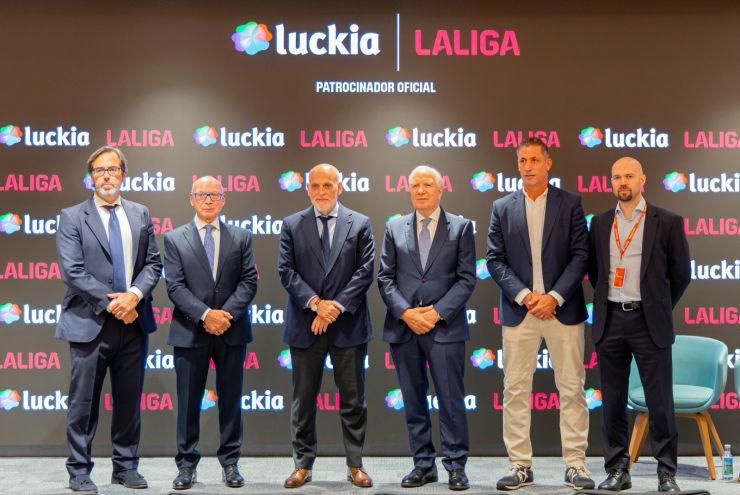
LaLiga and Luckia have decided that two seasons together were only the beginning. On Thursday 10 September 2026, Spain's top football league announced that the Spanish gaming and entertainment group will remain an official partner for three more seasons, taking the relationship through the 2028/29 campaign. The renewal was signed at Luckia's headquarters in A Coruña, in Galicia, with LaLiga president Javier Tebas, Luckia president José González and vice president Alfredo González all in the room, according to LaLiga's own announcement.
The ceremony had a football flavour of its own. Joan Capdevila, the former Spain international and Deportivo de A Coruña defender whom LaLiga calls one of its legends, joined the signing, and the first teaser of Luckia's campaign for the new season, starring Capdevila, was presented on the day. Focus Gaming News and SBC News both reported the same line up, and Sportcal and Inside World Football confirmed that the extension runs for three seasons, through 2028/29. No financial terms were disclosed by either party.
On paper this is a routine renewal. In practice it is one of the more instructive sports betting partnerships in European football, because it shows how a gambling brand can build a visible, long term presence around a top league in a country that has some of the strictest gambling advertising rules in Europe. Spanish clubs cannot carry betting logos on their shirts. Stadiums cannot be named after operators. Gambling adverts on television, including those caught on camera during live matches, are confined to a window between one and five in the morning. So what exactly does a betting brand buy when it signs with LaLiga, and why would it come back for more?
The partnership first began in August 2024, when LaLiga named Luckia a new official partner for three seasons in Spain and Mexico. LaLiga's announcement at the time said the deal covered LaLiga EA Sports and LaLiga Hypermotion, the first and second divisions, in both countries, and that Luckia would use more of the league's digital assets to raise its visibility and reach new audiences. SBC News described it as Luckia's largest sponsorship commitment, with activation planned through ambassadors, official merchandise and ticketing sold through Luckia's online and retail channels. Both sides stressed from day one that every activity would follow the applicable regulations in each country.
The renewal keeps the same philosophy. According to SBC News, Luckia gains access to an expanded marketing inventory that includes digital content, social media, matchday campaigns, fan experiences and brand activations. Existing content properties continue. LaLiga's announcement lists the shows the partners have produced together, including "La previa de Luckia" and "El golazo de Luckia", and campaigns such as "Donde hay fútbol, hay Luckia" ("Where there is football, there is Luckia") that turned the brand's four leaf clover into a familiar sight around the competition.
A growing part of the plan is Luckia Tréboles F.C., the company's Instagram and TikTok channel, which shares football trivia and lesser known stories aimed at younger adult fans. A roster of former players has appeared in the partnership so far, among them Guti, Fernando Morientes, Gaizka Mendieta, Miguel Ángel Moyá, Diego Godín, Javier Mascherano, Julio Baptista and now Capdevila. SBC News added an important detail: Luckia's football ambassadors will also take part in LaLiga's safer and responsible gambling campaigns. That small clause says a great deal about how sports sponsorship in this category has to be framed in Spain.
The quotes were published in Spanish by LaLiga, and the English versions below are our own translations. Javier Tebas said: "We are very satisfied to extend our collaboration with Luckia until 2029. And I am glad that this is happening, because it means that this relationship is working." He then made a broader point about the industry: "Sports sponsorship has changed, and today it is not enough to associate a logo with a competition. You have to connect with fans, create real experiences and build a credible relationship with audiences. That takes time, and the renewal until 2029 is a real statement of intent from both parties."
José González, for his part, said that "the renewal of our alliance with LaLiga until 2029 is a very important step for Luckia" (translated). He added that since the first agreement the company has seen "the enormous potential" of the collaboration to connect the brand "with millions of fans", and that "we share with LaLiga values such as effort, teamwork, perseverance and passion" (also translated). He closed by saying the company is "convinced that this new stage will allow us to keep innovating". Both sides described the aim as taking football beyond the 90 minutes of a match through 2029.
Tebas's remark about logos is worth reading twice. In most markets it would sound like standard marketing language. In Spain it is also a description of the law, because a logo on its own, placed where a television camera will catch it during a live game, is precisely the kind of exposure the rules restrict.
Luckia is not a pure online brand that arrived with the regulated market. It belongs to Grupo EGASA, a group founded in 1972 in A Coruña with interests in leisure, hospitality and property. According to SBC News, EGASA brought its entire gambling portfolio, both retail and online, under the Luckia Gaming brand in 2016, and the group employs around 2,500 people. LaLiga describes Luckia as an entertainment company present in eight countries, and it is as much a high street business as an online one.
The numbers show the scale. Focus Gaming News reported that Luckia's consolidated revenue passed 600 million euros for the first time in 2024, at 603 million euros, up 6% on the year, with EBITDA of 58.3 million euros. iGaming Expert then reported in August 2026 that 2025 revenue reached 632.1 million euros, up 4.8%, while net profit rose 71% to 20.8 million euros. Gaming and sports betting, combining retail and online, brought in 369.2 million euros, or 58% of turnover. Gaming halls added 137.1 million euros, casinos 84.9 million euros and bingo just under 26 million euros. Spain generated 550.9 million euros, about 87% of the total, with Latin America close to 10% and the rest of the EU under 3%.
Outside Spain, Luckia runs land based casinos in Croatia, Chile, Peru and Colombia, according to iGaming Expert, and it recently bought the remaining 50% of Egasa Colombia to take full ownership. In Spain it operates six casinos, in Bilbao, Ceuta, Mallorca, San Sebastián, Vigo and A Toxa. SBC News noted that EGASA is evaluating further expansion in Latin America, where LaLiga's large following could support those plans. That helps explain why the original deal covered Mexico as well as Spain, and why a league partnership, with its international audience, suits a group that sells both online gambling and physical casino entertainment.
To understand why this partnership looks the way it does, you have to start with Royal Decree 958/2020 on commercial communications for gambling, which has applied since 5 November 2020. When the measures were first announced in July 2020, SBC News reported that eight LaLiga clubs, Valencia, Alavés, Leganés, Granada, Mallorca, Sevilla, Osasuna and Levante, had a gambling company as their main shirt sponsor. All of those deals had to go.
Article 12 of the decree, which deals with sponsorship, is short and very direct. According to the consolidated text published in Spain's official gazette, the BOE, it bans sponsorship on sports shirts and kits. It bars operators from using their name to identify a sports facility or entertainment venue, or from replacing the name of a team or a competition with their own. It forbids sponsorship of sports events or broadcasts aimed at minors, and it says the sponsor's brand cannot appear on events, goods or services designed for minors. Finally, it says that any commercial communication placed through media inside sports facilities must respect the time limits that apply to audiovisual services.
Those time limits are the second pillar. Article 18 says gambling communications on audiovisual services may only be broadcast between 01:00 and 05:00. Article 19 applies the same window to live broadcasts of sporting and other competitive events, and it makes clear that this covers any commercial communication physically placed in the venue and captured by the broadcast. In other words, a betting brand's perimeter board at a LaLiga stadium does very little for that brand during a Saturday evening kick off on Spanish television.
Read together, these rules close the classic doors of football sponsorship: the shirt, the stadium name, the competition name and live television exposure. What they do not ban is a commercial partnership with a league as such. That is the space Luckia occupies, and it explains why the official announcements put so much weight on digital content, social channels, fan experiences and ambassadors rather than on visibility inside the ground.
The decree has not stood still. In April 2024 Spain's Supreme Court, ruling on appeals brought by the digital gaming association Jdigital and the media body AMI, annulled several provisions because they had been imposed by regulation without sufficient backing in the 2011 Gambling Law. According to Focus Gaming News and the annotations on the BOE text, the annulled parts include paragraphs 1 and 3 of Article 13 on promotions aimed at new customers, Article 15 on the use of famous people in advertising, Article 23.1 on online commercial communications, and parts of Articles 25 and 26 on video sharing platforms and social networks. Covers and Focus Gaming News both reported that the court left the sponsorship restrictions in place, and the BOE text shows no annulment note on Article 12 or on the broadcast window in Article 18.
That ruling is one reason why a partnership built on well known former footballers is possible today. With Article 15 gone, the 2020 decree no longer stops operators from working with recognisable faces. But the government has made it clear that it wants that door shut again. In October 2024 Focus Gaming News reported a first attempt to reinstate the annulled rules through an amendment to an unrelated decree, and Gambling Insider later reported that a separate attempt to change the Gambling Law through the Customer Service Law failed after the Senate removed the changes.
In May 2026 the Ministry of Social Rights, Consumer Affairs and Agenda 2030 opened a public consultation on reforming the Gambling Law. The ministry's own note, dated 19 May 2026, said the reform would cover the presence of celebrities and influencers in gambling advertising, new limits on promotions used to attract customers, a rule that operators' search results should only appear when a user's search is directly related to betting, and mandatory risk warnings in a format similar to tobacco packaging, including the information that there is a 75% probability of losing money. Gambling Insider reported that Minister Pablo Bustinduy wants a ban on athletes, streamers and celebrities in betting and casino adverts to have the force of law.
Separately, Royal Decree 520/2026 was published in the BOE on 25 June 2026. According to the law firm Cuatrecasas, it creates a system of joint deposit limits across operators, with default caps of 700 euros a day, 1,750 euros a week and 3,300 euros every four weeks, taking effect on 25 March 2027. None of this touches league partnerships directly, but it shapes the commercial case for every operator that is spending money on football.
If shirts, stadium names and live television are out, why spend on LaLiga at all? The first answer is scale. Spain's regulated online gambling market reached a record 1,700.55 million euros in gross gaming revenue in 2025, according to DGOJ figures reported by Gambling Insider. Casino accounted for 52.51% of that total and sports betting for 41.05%, with betting up 14.92%. Operators spent 664.40 million euros on marketing, up 25.84%, and sponsorship spending rose 140.15%. Whatever the restrictions, operators clearly still see value in being close to sport.
The second answer is association. A league partnership gives a brand the right to call itself an official partner of the competition, to use league marks in its own campaigns, to produce content with league ambassadors and to offer fans official experiences, tickets and merchandise. That is a different product from a shirt logo, and in a restricted market it is arguably the more useful one, because it can live on owned channels, in retail venues and on social media throughout the week rather than for ninety minutes on a Saturday.
The third answer is credibility. By committing its ambassadors to LaLiga's safer gambling campaigns, Luckia ties its brand to the league's responsible gambling message. For a regulator watching the category closely, and for a league that wants to keep commercial income from the sector, that framing matters. Tebas's line about building a credible relationship with audiences is commercial advice, but it is also a survival strategy for betting sponsorship in Spain.
Finally, there is reach. In 2024 SBC News quoted Luckia's chief marketing officer citing a league digital audience of 200 million social media followers across 16 platforms in 20 languages. For an operator with casinos in Latin America, a league badge travels well.
For operators looking at football in heavily regulated markets, the Luckia renewal offers a practical template. Start from what the law allows, not from what a traditional sponsorship package contains. In Spain that means league or competition rights, digital and social content, ambassador led storytelling, fan experiences and responsible gambling messaging, rather than shirts, naming rights and broadcast exposure. Good iGaming consulting begins with that legal map, because a package full of assets you cannot use is money wasted.
Second, treat content as the core asset. Shows such as "La previa de Luckia", a channel like Luckia Tréboles F.C. and a steady flow of ambassador campaigns give a brand reasons to talk to fans every week. That is content marketing in its purest form, and it is far less exposed to time windows than a perimeter board. It also lets an operator speak to sports fans without leading with odds or bonuses, which suits a regulator that is moving to restrict promotions further.
Third, think in multi season terms. Tebas said building real relationships with audiences takes time, and the move from a three season deal in 2024 to a renewal through 2029 reflects that. Short deals in restricted markets rarely give a brand enough time to build recognition through content alone. Fourth, plan for regulatory change. The use of celebrities and influencers, the most visible part of Luckia's activation, is exactly the area Spain's consumer ministry wants to regulate by law. A smart operator builds a partnership that would still work if ambassador rules tighten, with league marks, owned content and fan experiences carrying the weight.
Fifth, use the omnichannel advantage if you have one. Luckia's mix of online gambling, betting shops, gaming halls and casinos allows it to sell official merchandise and tickets through physical as well as digital channels, which was written into the original deal. Pure online operators cannot replicate that easily, and it is one reason a land based group can extract more value from a league partnership than its marketing budget alone would suggest.
Spain is not the only country where gambling brands, sports bodies and regulators are working out new rules of engagement. Across Europe and beyond, the direction is similar: fewer logos in front of children, more scrutiny of celebrities and bonuses, and more emphasis on responsible gambling. Leagues that want to keep betting and casino brands as partners are learning to offer packages built around content, data, experiences and digital audiences. Specialist iGaming consulting increasingly means mapping those differences market by market before a single contract is signed. Operators who understand that shift will find more value in sports sponsorship than those still chasing the front of a shirt.
The same thinking applies to brands from any sector that are exploring sports sponsorship opportunities in Dubai and the wider Gulf, where sports properties are growing fast and where every category has its own sensitivities. The lesson from LaLiga and Luckia is simple: know which assets the rules allow, choose a partner whose audience fits your business, and invest in the story rather than the logo. For iGaming brands, and for anyone offering iGaming consulting to them, the Spanish model shows that strict advertising rules do not end sports betting sponsorship. They change what a good deal looks like, and they reward patience, content and a clear responsible gambling message.
A short note on what happened next. On 6 October 2026, Gambling Insider reported that Spain's general election had been called for 29 November, which means the Gambling Law reform, still at the consultation stage and never sent to parliament, can only be taken up in the next legislature. Its final scope will depend on the next government, so the current rules, including the sponsorship limits that shaped the Luckia deal, remain the reference for now.
Sources: LaLiga, SBC News, Sportcal, Inside World Football, Focus Gaming News, iGaming Expert, Gambling Insider, Covers, BOE (Boletín Oficial del Estado), Spanish Ministry of Social Rights, Consumer Affairs and Agenda 2030, Cuatrecasas, DLA Piper