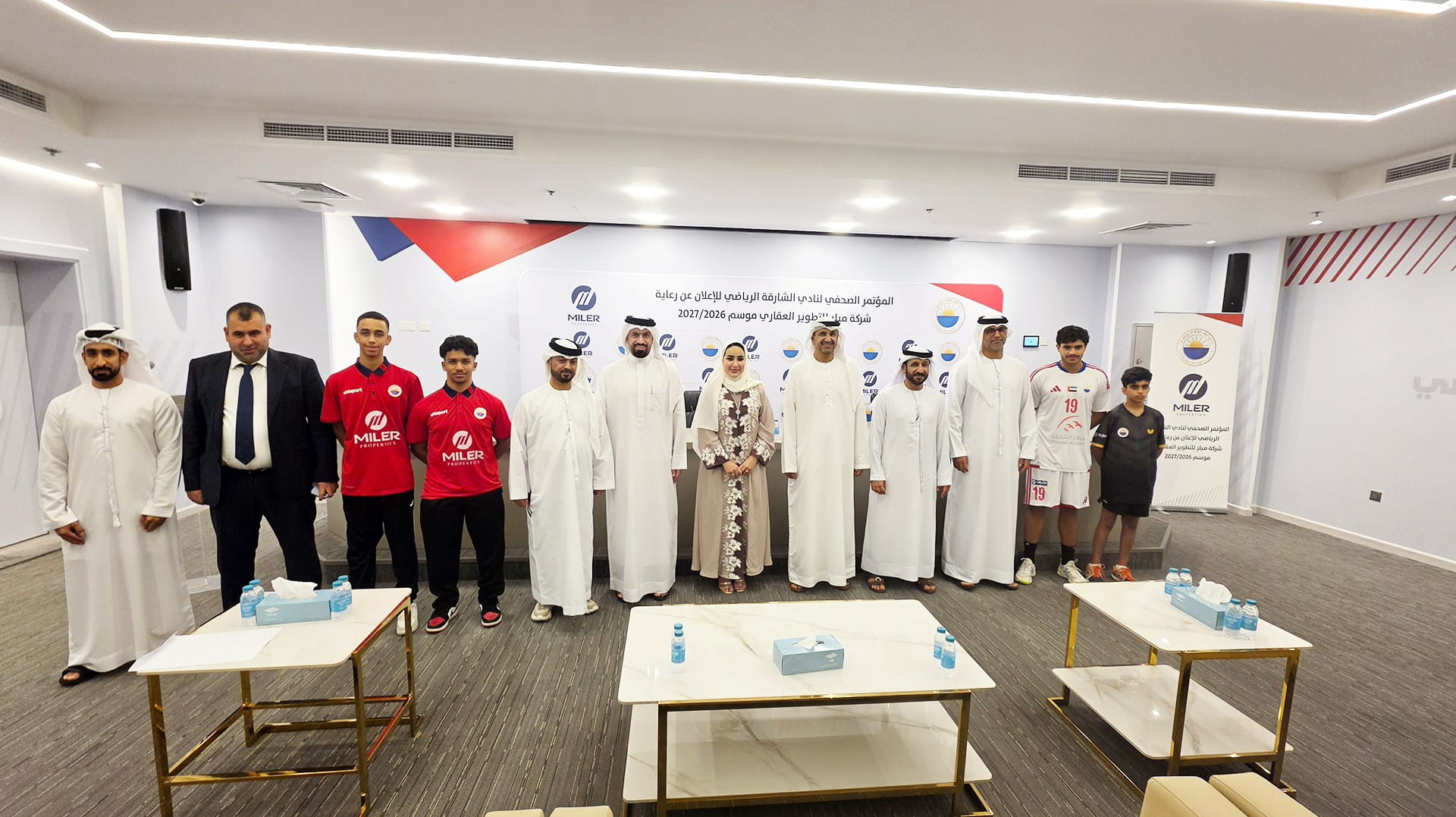
Sharjah Sports Club has added another local company to its list of commercial partners. At a press conference on 6 October 2026, the club's Chairman of the Board, Mohammed Juma bin Hindi, announced a sponsorship agreement with Miler Properties, a Sharjah real estate developer. According to Sharjah 24, he told the room that "today's press conference was held to announce a sponsorship agreement with Miler Properties." No fee, duration or list of rights was made public.
A second Sharjah 24 report published the same evening filled in the most important detail. The agreement covers two of the club's individual sports: the karate team and the table tennis team. Those are not the headline squads that fill a stadium on a Friday night, but they are two of the most decorated programmes inside one of the most successful multi sport clubs in the country, and that is exactly what makes the deal interesting.
For anyone following sports sponsorship in the UAE, the Miler agreement is a useful case study. It shows a property brand choosing a focused, affordable entry point into a famous club rather than chasing the front of a football shirt, and it shows how Sharjah's clubs are building a steady base of local partners around their less visible teams. Below we look at what the deal covers, why a developer would back karate and table tennis, how real estate money is moving into Sharjah sport, and what the club itself has been achieving on and off the football pitch.
The facts that have been published are clear, if limited. Sharjah Sports Club announced the partnership at a press conference on 6 October. Mohammed Juma bin Hindi framed it as part of the club's wider strategy of building partnerships with supporting bodies in Sharjah. In the Arabic edition of Sharjah 24, the company is described as Miler Real Estate Development, and the English edition calls it Miler Properties.
The sponsored teams were named by Engineer Suleiman Abdulrahman Al Hajri, a board member and Head of the Individual Sports Department at the club. He thanked Miler for its backing of the karate and table tennis squads and said the partnership reflects "the private sector's firm belief in the importance of sports." He also described "sporting success" as "a shared responsibility" that needs clubs and national companies to work together, and he called the sponsorship "genuine support for the players' ambitions" and "a powerful catalyst for them to continue working hard."
What has not been disclosed matters too. Neither report gives a contract value, a length of term or a list of assets such as logo placement on uniforms, branding at the club's halls or digital rights. No Miler executive was quoted in either article. That is not unusual for club level deals in the UAE, where the announcement often focuses on the club's gratitude and the sponsor's commitment to the community, while the commercial detail stays private.
Miler also joins a familiar pattern at the club this season. Sharjah Airport renewed its long running sponsorship of the handball team in August, and Jamix Gold Ready Mix Concrete renewed its backing of the handball and judo teams for a third year in early September, both as reported by Sharjah 24.
At first glance, karate and table tennis look like unusual choices for a real estate company. Football is the sport with the television audience and the social media reach. But for a developer whose customers are families looking for a home in Sharjah, the logic of individual sports is easy to follow.
Karate and table tennis are participation sports. They are full of children, teenagers and parents who spend their weekends at training halls and local tournaments. A brand that appears in that environment is associated with discipline, youth development and community, values that sit comfortably next to the idea of building homes for families. It is a different kind of brand awareness from a logo on a football shirt: smaller in reach, but closer to the people a local developer actually wants to talk to.
The numbers in Sharjah's property market explain why developers are keen to be visible. According to Khaleej Times, real estate transactions in the emirate reached Dh29.5 billion in the first half of 2026, up 9.3 per cent on the same period a year earlier. The number of transactions rose 23.7 per cent to 59,460, investors came from 121 nationalities, and residential property made up 82.2 per cent of sales. UAE nationals accounted for around Dh14.9 billion of that activity. In a market that busy, local developers compete hard for attention, and sports sponsorship offers a way to stand out with a message rooted in the community rather than in price alone.
There is also a cost argument. Sponsoring an individual sports team at a big club is generally far cheaper than buying a premium position on a football kit, yet it still lets the sponsor use the club's name in its own communications, attend award ceremonies and share in the stories of medal winning athletes. For a growing company, that is an efficient way to start a relationship with a club that can later expand into larger sponsorships if both sides are happy.
Miler is not the first property company to put its name next to Sharjah Sports Club. In October 2025, the club's investment and sports marketing company signed a deal with Al Rasikhoon Real Estate. According to Sharjah 24, that agreement put the developer's logo on the front of the first team football jersey during the AFC Champions League Elite, as well as across the club's media platforms and facilities. The same report noted that the first team shirt already carried six sponsors in local tournaments, the maximum that league regulations allow.
That detail is worth pausing on. When the football shirt is full, a club with many teams still has plenty to offer. Handball, judo, karate, table tennis, basketball and other sports each have their own uniforms, venues, fixtures and athletes. For a club with this many programmes, the commercial inventory is far wider than one jersey, and companies like Miler, Jamix Gold and Sharjah Airport are taking advantage of that by attaching their names to specific teams.
Property developers have been visible in UAE football sponsorship for years. Gulf News reported in 2018 that Shabab Al Ahli Dubai signed a strategic partnership with Azizi Developments, and that Emaar Properties had earlier been the name on the club's shirt for the 2017 to 2018 season. Sharjah's own property sector is now following a similar path, but with a local flavour: the deals are often smaller, closer to home and spread across several sports rather than concentrated on one marquee team.
Sharjah Sports Club has also relied on a broad base of supporters from other sectors. In June 2023, Sharjah 24 reported that the club honoured 23 travel agencies that had sponsored its sports teams during the 2022 to 2023 season. Taken together, these examples suggest a club that treats sponsorships as a network of many partners rather than a single big cheque, and that is a model brands should understand before they approach it.
If Miler wanted to back winners, it chose well. Sharjah Sports Club's karate programme has been dominant at national level. In April 2026, the club retained the UAE Karate Cup men's kumite title for the second year in a row, winning 11 medals (six gold, one silver and four bronze) at its own Al Hazana sports hall, according to Sharjah 24. Later the same month, the club won the General Karate League men's kata title for the 16th consecutive year, while its junior team lifted the league shield for the fifth time in its history. That tournament brought together 180 male and female athletes from 13 clubs across the UAE.
The wider individual sports department has been just as productive. In mid April 2026, Sharjah 24 reported that the club had won 530 medals in individual sports since the start of the 2025 season, not counting swimming. It had also collected 17 team championships, 14 of them in karate and one each in judo, table tennis and taekwondo, and 45 of its athletes were representing national teams. Al Hajri, who leads the department, has been the public face of that success, crediting long term planning and the support of the club's board.
Table tennis has its own momentum. In May 2026, the club's junior team won the Junior Table Tennis League for the second year running, beating Al Nasr 3-0 to seal the title a round early and finishing the campaign unbeaten. Al Hajri said at the time that the club had won three table tennis league titles that season. Then, on 12 September 2026, less than a month before the Miler announcement, Sharjah won the Table Tennis Federation Cup, the first competition of the new season, again beating Al Nasr 3-0 in the final at Shabab Al Ahli Club's hall in Dubai. Ahmed Saeed Al Mushaibi, Mohammed Saeed Al Mushaibi and Batur Perovic won the three rubbers.
For a sponsor, this is valuable material. Every medal, cup final and national team call up is a story that can be shared on social channels, in newsletters and at the sponsor's own events. That is where good content marketing turns a modest sponsorship into a visible one, and it is often the difference between a deal that is quietly renewed and one that grows.
Sharjah Sports Club is best known abroad for football, and the last two seasons have given it a place in Asian football history. On 18 May 2025, Sharjah beat Lion City Sailors 2-1 in the AFC Champions League Two final at Bishan Stadium in Singapore, in front of around 10,000 fans. According to Arab News, Firas Ben Larbi put Sharjah ahead in the second half, Maxime Lestienne equalised in injury time, and Marcus Meloni curled in the winner in the 97th minute. It was the club's first continental title, and the last trophy for coach Cosmin Olaroiu before he left to take charge of the UAE national team. "It means a lot for us, the country and the fans and we worked so hard for this," Meloni told Arab News.
That win took Sharjah into the 2025 to 2026 AFC Champions League Elite, where the club produced one of the results of the league phase. On 24 November 2025, Sharjah won 1-0 away to Saudi side Al Ahli, the defending champions, in Jeddah. The Asian Football Confederation reported that Ousmane Camara scored in the 81st minute and that the result ended Al Ahli's 22 match unbeaten run in the competition. Head coach Abdulmajid Al Nimr credited the team's preparation. The campaign ended on 16 February 2026, however, with a 2-1 home defeat to Nasaf of Uzbekistan, which left Sharjah ninth in the league phase table with eight points and out of the competition, according to Sharjah 24.
The domestic season was harder. When Al Ain clinched the 2025 to 2026 ADNOC Pro League title with a 5-0 win at Sharjah Stadium on 6 May 2026, Dubai Eye 103.8 reported that Sharjah were tenth with 25 points. Sharjah does not appear in the AFC Champions League Two group draw for 2026 to 2027 published by The Peninsula, which lists Al Wahda and Al Jazira as the UAE's representatives. The new league season has started with mixed results, including a 2-0 defeat away to Al Jazira and a 3-0 win at Hatta on 30 August, when Gilmar scored twice and Laba Kodjo added the third, according to Sharjah 24.
Football is only part of the picture. The club's handball team won the 27th Asian Men's Handball Clubs League Championship in Doha in November 2024, beating Saudi club Al Khaleej 27-26 in the final. According to the Sharjah Government Media Bureau, it was the first continental title in the handball team's history, and the Ruler of Sharjah announced a reward of AED 5 million for the squad. The club also runs basketball, judo, taekwondo, cycling and more, which is why Mohammed Juma bin Hindi spoke on 6 October about medals won "at Asian and Arab levels" across individual and team sports.
Sharjah's clubs operate in an environment of strong public backing. At the Miler press conference, bin Hindi credited His Highness Sheikh Dr Sultan bin Mohammed Al Qasimi, Supreme Council Member and Ruler of Sharjah, with giving sport special attention. He said that partnerships such as this one "directly contribute to advancing the club's athletes" and are a key pillar for continued success, according to Sharjah 24.
That support is concrete. In December 2025, Gulf News reported that the Ruler had announced a Dh26 million reward for 21 Sharjah clubs that won titles or championships during the 2024 to 2025 season, with Sharjah Club named among the recipients. The money was intended to upgrade facilities and help teams prepare for future competitions.
For sponsors, this matters in two ways. First, public investment means clubs have well run facilities, active youth programmes and a busy calendar of competitions, which gives a brand more moments to be seen. Second, private sponsorship is clearly encouraged. When club leaders say on the record that national companies share responsibility for sporting success, they are inviting more brands to join, and they are signalling that sponsors will be thanked publicly for doing so.
The Miler deal offers a practical template for companies looking at sports sponsorship opportunities in Sharjah. The first lesson is that you do not need to start with football. A multi sport club offers many doors in, and individual sports teams with a strong record of medals can deliver meaningful brand awareness at a fraction of the cost of a football shirt position.
The second lesson is about fit. A real estate company backing youth heavy sports such as karate and table tennis makes sense because the audience matches its customers: families who live in the emirate and spend time at the club. Brands in education, healthcare, retail, banking and food can apply the same thinking. The question is not "which team is most famous?" but "which team's community looks most like my customer?"
The third lesson is about activation. A sponsorship that stops at a logo rarely pays back. The partners who get the most from UAE football club sponsorship and from smaller team deals are those who tell the athletes' stories, show up at tournaments, run clinics and share results on their own channels. Event sponsorship of a single tournament hosted at the club's hall can be a sensible first test before a full season commitment. With Sharjah's karate and table tennis teams winning titles regularly, Miler has a steady flow of good news to work with, if it chooses to use it.
Finally, brands should go in with clear objectives and a way to measure them. That can mean tracking social engagement around team results, leads generated at club events, or how often the sponsorship is mentioned in local media. Sports branding works best when it is part of a joined up plan that includes digital advertising, on site presence and community activity, rather than a standalone badge. Good sports marketing in Sharjah also respects the club's own voice: the most effective partners let the club and its athletes lead the story, and add their brand to it.
The next step for this partnership will be visible on the mats and at the table. Sharjah's karate squad will be defending a long run of national titles, and the table tennis team has already opened the season by winning the Federation Cup. If Miler's branding appears on uniforms, at events and in the club's media, the deal will start to build real recognition for the developer among families in the emirate.
It will also be worth watching whether more property developers follow. Al Rasikhoon took the football shirt route during the club's Asian campaign, and Miler has now gone for individual sports. With Sharjah's property market growing and its clubs actively seeking partners, there is room for more of these deals across football, handball, basketball and the individual sports that keep producing medals.
For brands weighing their own move into UAE sport, the message from Sharjah is encouraging. Clubs are open to partners of every size, the sports calendar is full, and a well chosen sponsorship, properly activated, can put a company at the heart of the community it wants to serve.
Sources: Sharjah 24, Arab News, Asian Football Confederation, Khaleej Times, Gulf News, Dubai Eye 103.8, The Peninsula, Sharjah Government Media Bureau