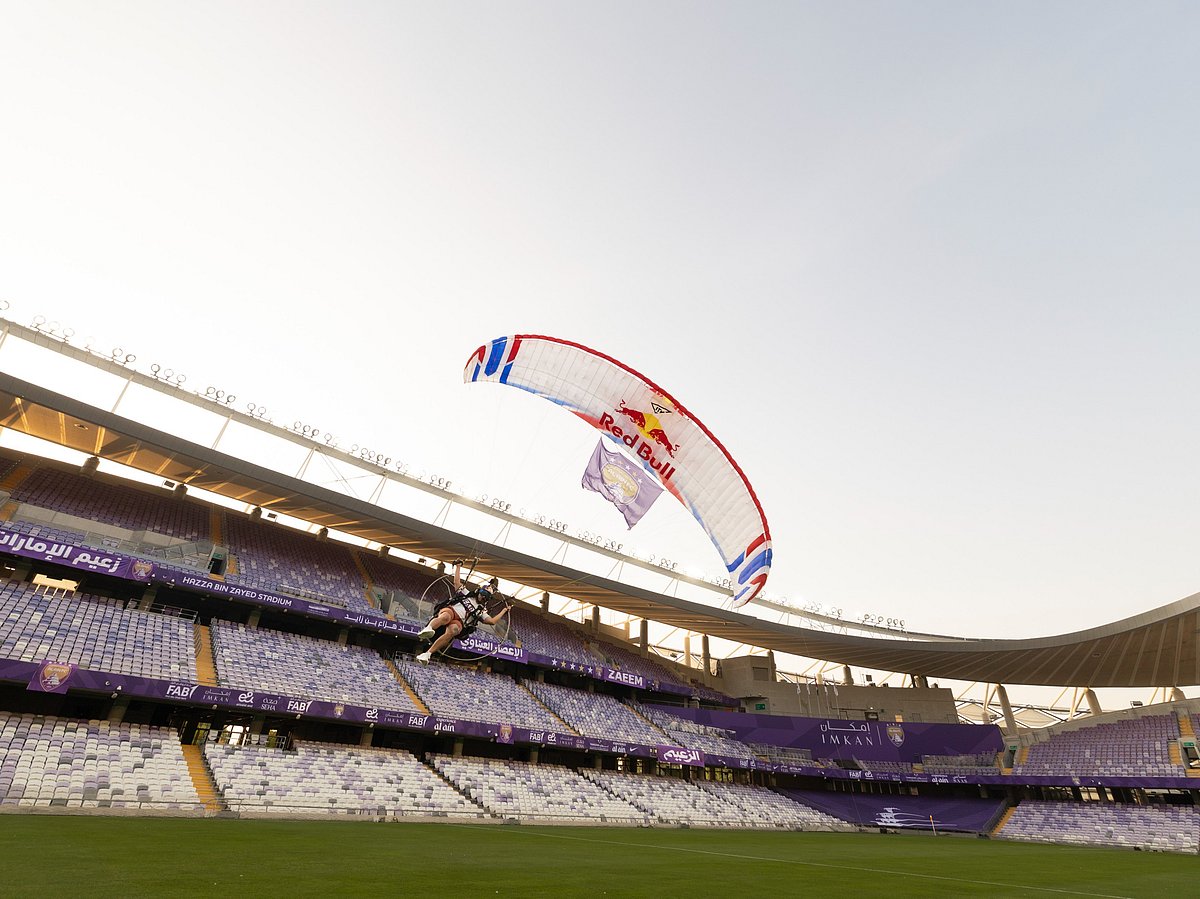
Al Ain Club has signed partnerships with banks, airlines, energy giants and tyre makers over the years, but few of them have arrived quite like this one. On 13 October 2026 Red Bull and Al Ain Club announced a new strategic partnership, and to mark the moment Red Bull paramotor athlete Dimitris Kolliakos flew into the club's home ground, Hazza bin Zayed Stadium, under a motorised wing. It was a launch that could only belong to one brand.
According to Gulf News, which reported the deal on the day, the partnership is built around three ideas: high performance, innovation and talent development. Its stated aim is to build on the club's success in the UAE and across Asia, and to open new routes for developing football talent in the country. Grassroots development sits at the centre of it, with Red Bull's experience in high performance training academies and youth scouting set to help Al Ain identify and nurture emerging players.
What the deal is not matters almost as much as what it is. Inside World Football described it as a lighter touch arrangement than the ownership and investment deals Red Bull has struck elsewhere in football. No stake is being bought, Al Ain is not expected to join Red Bull's multi club structure, and neither the length of the agreement nor its value has been disclosed. For anyone who follows sports sponsorship in the Gulf, that combination of a global brand, a decorated club and a knowledge based relationship makes it one of the more interesting football partnerships signed in the UAE this year.
The official wording from both sides is short and deliberately broad. The press release, published by Mid-East.info on the day of the announcement and mirrored by Gulf News and Campaign Middle East, says the two parties will collaborate across high performance, innovation and talent development. The partnership, it says, will draw on Red Bull's global sporting experience to support Al Ain's ambitions at home and abroad.
Al Ain Club's own announcement, published on its website, frames the agreement in similar terms. The club says the deal gives it access to Red Bull's expertise in professional sport and intensive performance training programmes, and that it will help the club discover, nurture and develop young players while supporting the growth of UAE football and the club's international presence. The club describes Red Bull as a leading global sports institution as well as a commercial brand, which tells you how Al Ain wants supporters to read the relationship: as a technical alliance first and a commercial one second.
The release also sets a wider ambition. It says the partnership aims to raise the profile of UAE football, connect local talent with a global sporting community and showcase the country's game to audiences around the world. That last point is where the brand side of the deal comes in, and it explains why the launch was staged as a spectacle rather than a signing behind closed doors.
Inside World Football, which reported the story a day later, added the useful detail. In its reading the agreement will focus at first on high performance programmes and on the identification and development of youth players, with Al Ain also keen to draw on Red Bull's wider sporting knowledge. It noted that no player sharing agreement, joint academy or embedded Red Bull staff has been announced, and that it remains unclear whether Red Bull's scouting systems, coaching methods or football personnel will be shared directly with the club. No financial terms or contract length were made public by either side.
To understand what Al Ain may gain, it helps to look at what Red Bull has built in football over two decades. Inside World Football lists the core of the network as RB Leipzig in Germany, Red Bull Salzburg in Austria, the New York Red Bulls in Major League Soccer and Red Bull Bragantino in Brazil. In August 2024 Red Bull added Japan, buying all of the shares in Omiya Ardija from NTT, according to Wikipedia, and the club now plays as RB Omiya Ardija with a crest that matches the rest of the family. Austria's FC Liefering serves as a feeder club to Salzburg.
Red Bull has also moved beyond full ownership. Inside World Football points to minority positions in Leeds United and a 10.6 per cent stake in Paris FC, deals that brought the company into English and French football without taking control. The Al Ain agreement goes one step lighter again: no equity at all, but a structured exchange of know how.
That know how is the real asset. Red Bull runs its clubs around a shared football philosophy, and the group invests heavily in the people who carry it. When Red Bull appointed Jürgen Klopp as its Head of Global Soccer, in a role that began in January 2025, the company said he would provide strategic vision and support the individual sporting directors of its clubs in advancing the Red Bull philosophy, according to Flashscore, with global scouting and the mentoring of coaches named as part of the brief. Klopp said he saw his role "primarily as a mentor for the coaches and management of the Red Bull clubs". For a club like Al Ain, even partial access to that way of thinking about recruitment and player development is a meaningful advantage.
There is also a precedent for this type of arrangement in the Arab world. Inside World Football reported on an earlier Red Bull partnership with Egypt's Al Ahly that was likewise not a traditional sponsorship, with no heavy logo placement, and was built instead around international marketing campaigns, fan engagement and Red Bull's sports science expertise for player conditioning. The Al Ain deal fits that pattern of Red Bull choosing big, successful clubs in the region and attaching its name to performance rather than to a shirt.
Most partnerships are launched with a handshake, a framed shirt and a photo in front of a sponsor wall. Red Bull launched this one from the sky. Gulf News reported that Dimitris Kolliakos flew into the stadium by paramotor, and the release framed the stunt as a symbol of a shared drive to push limits, pursue peak performance and create innovative experiences. Campaign Middle East, the regional marketing trade title, covered the deal precisely as a paramotor activation and tagged it under sports marketing and brand partnerships, which shows how the industry read it.
It is a textbook example of Red Bull's approach to sports marketing and sports branding. The company rarely buys attention in the conventional way. It manufactures moments that are worth filming, then lets those moments travel across social feeds, news sites and club channels. A pilot landing inside a football stadium is exactly that kind of moment. It gives Al Ain fresh content to share with supporters, it gives Red Bull footage that sits naturally alongside its extreme sports catalogue, and it gives media outlets a reason to write about a partnership whose financial details are not even public.
For marketers, the lesson is that the launch is part of the asset. A partnership announced through a stunt earns far more brand awareness than one announced through a press release alone, because it creates images people want to look at. That is why so much of the value in modern sports sponsorship now sits in content marketing rather than in static signage. The rights are the starting point. The story you tell with them is where the return is made.
The venue was not new territory for Red Bull either. In February 2026 Hazza bin Zayed Stadium hosted the UAE national final of Red Bull Four 2 Score, the brand's four a side street football tournament, according to Gulf Today. The format uses no goalkeepers and ten minute matches, with goals in the opening and closing minutes counting double. A team called Al Ain City beat M2 2-1 in that final to earn a place at the world final in Toronto on 29 August 2026, with UAE developer Arada partnering on the national qualifiers. Seen in that light, the partnership with the club that owns the stadium looks like the next logical step in a relationship with the city.
The Red Bull deal is a useful marker for anyone weighing UAE football club sponsorship. It shows that the most valuable partnerships in the region are no longer only about logo placement. In the best sponsorships, brands are looking for roles they can genuinely play, whether that is sports science, technology, youth development or fan experience, and clubs are increasingly willing to package those roles as strategic partnerships rather than as simple advertising inventory.
Al Ain already runs a broad commercial portfolio. When the club celebrated its 2025 to 2026 league title in May, the Abu Dhabi Media Office reported that ADNOC, First Abu Dhabi Bank, e& and Emirates were among the strategic partners and sponsors honoured on the night. Earlier in the year, according to a release distributed by PR Newswire, Hankook Tire and its UAE distributor Al Dobowi signed a three season partnership with the club that included LED advertising at Hazza bin Zayed Stadium, a VIP hospitality programme and the Ainawi Membership season card scheme. Red Bull now adds a very different kind of name to that list, one that brings expertise as well as reach.
For brands, the takeaway is that there are still real sports sponsorship opportunities in Dubai and across the Emirates for companies willing to think beyond the shirt. A partnership can be built around a youth programme, a performance department, a matchday experience or a single memorable activation. The structure of the Red Bull and Al Ain deal, with its focus on knowledge and grassroots, also suggests that clubs in the UAE are becoming more sophisticated about what they ask partners to bring. That raises the bar, but it also creates space for brands that can offer more than money.
It is equally a reminder that event sponsorship thinking belongs in every football deal, and that activation needs planning. Red Bull did not simply sign a contract. It announced the deal in the middle of a busy Asian campaign, staged a launch at the club's own stadium and created a piece of content that every outlet covering the story could use. Those choices are where a smart brand strategy turns a partnership into public attention.
Red Bull has chosen its partner carefully. Founded in 1968, Al Ain is known as Al Zaeem, the Boss, and the nickname is earned. In May 2026 the club won the 2025 to 2026 ADNOC Pro League, its 15th league title, and the Abu Dhabi Media Office reported that the triumph raised Al Ain's tally to 39 official titles across all competitions. The celebration took place at Hazza bin Zayed Stadium in the presence of Sheikh Hazza bin Zayed Al Nahyan, the Ruler's Representative in Al Ain Region, while Sheikh Sultan bin Hamdan bin Zayed Al Nahyan attended as Chairman of the Al Ain Club Board of Directors. The ceremony also honoured the club's football school and academy teams for results from under 23 down to under 15 level, a detail that fits neatly with the youth focus of the Red Bull agreement.
The club's reach extends well beyond the UAE. Al Ain has been crowned champion of Asia twice, first in 2003 and again in 2024. In 2018, as hosts, the club reached the final of the FIFA Club World Cup before losing 4-1 to Real Madrid, according to Wikipedia.
Al Ain has also invested in the area the Red Bull deal targets most. According to the club's website, it built a new scouting department and appointed Gonçalo Bexiga, a former senior international scout at Benfica who covered Asia, Africa and Brazil, as Head of Scouting, with a brief to search for talent in Al Ain City, across the UAE and internationally. A structured exchange with Red Bull, whose clubs have built their reputation on finding and developing young players, should complement that work rather than replace it.
The 2024 AFC Champions League final remains the defining moment of Al Ain's modern history. According to Wikipedia's record of the final, Al Ain lost the first leg 2-1 to Yokohama F. Marinos at the Nissan Stadium on 11 May 2024 in front of 53,704 spectators. Two weeks later, on 25 May, they won the return leg 5-1 at Hazza bin Zayed Stadium before a crowd of 24,826, lifting the trophy 6-3 on aggregate. The victory also earned the club the final Asian place at the 2025 FIFA Club World Cup.
The stage for that night is the same stadium Kolliakos flew into. Hazza bin Zayed Stadium opened in 2014 and was designed by the London based firm BDP Pattern, according to Wikipedia. Its facade uses fabric elements inspired by palm tree trunks that can be lit by LEDs in a range of modes, and its roof was conceived as a parasol to shade spectators. The ground holds around 25,000 people, is owned and operated by Al Ain, and is named after Sheikh Hazza bin Zayed Al Nahyan. It has hosted the 2017 and 2018 FIFA Club World Cups and eight matches of the 2019 AFC Asian Cup, including a quarter final and a semi final.
For partners, that matters. A modern, distinctive stadium is a branding asset in its own right, and its visual identity gives every activation, from LED campaigns to a paramotor landing, a backdrop that looks good on camera.
The timing of the announcement also lines up with a strong start to Al Ain's new Asian campaign under head coach Vladimir Ivić. According to Gulf Today, the club opened the 2026 to 2027 AFC Champions League Elite with a 4-0 home win over Al Nassr, then won 4-1 away to Iraq's Air Force Club at the Basra International Stadium on Monday 12 October, the day before the partnership went public. Kaku opened the scoring, an own goal by Saed Al Rousan doubled the lead and El Houssine Rahimi scored twice before half time, leaving Al Ain top of the West Region with six points from two matches, eight goals scored and one conceded.
Ivić was not entirely satisfied, telling reporters, according to Gulf Today, "We must stay fully focused from start to finish." The demand for constant high performance is exactly the language Red Bull uses about its own football operation, which makes the fit between the two organisations look natural rather than forced.
A deep run in Asia would also give Red Bull's association with the club far more exposure across the continent. Continental football brings broadcast audiences, travelling media and new markets, and a partner linked to a winning side shares in that visibility without paying for traditional perimeter boards.
Three things stand out for marketers and rights holders in the UAE. First, partnership does not have to mean ownership or shirt branding. Red Bull and Al Ain have built a relationship around expertise and youth development, and that gives both sides credibility that a simple logo deal would not.
Second, activation is not an afterthought. The paramotor landing turned an undisclosed agreement into a story with pictures, and that story was picked up by news outlets, football business media and the region's marketing trade press within days. Strong sports branding comes from those kinds of moments, and they should be planned at the same time as the contract, not after it.
Third, the UAE football market is ready for more creative sponsorships, and for sports marketing that goes beyond the shirt. The country's leading clubs already carry blue chip partners, but the Red Bull model shows there is room for brands that bring capability, content and community as well as budget. Whether a company wants to build brand awareness among young fans, link itself to performance and innovation, or reach supporters across Asia through continental competition, there is a version of this approach that can work. It simply needs a clear idea, the right club and a launch worth watching.
For Al Ain, the partnership adds a global performance brand to a club that already sits at the top of UAE football. For Red Bull, it opens a door to one of Asia's most successful clubs without the cost or complexity of ownership. If the two sides can turn the promise of youth scouting and high performance into real players on the pitch, this could become a model other clubs in the Gulf will want to copy.
Sources: Gulf News, Inside World Football, Campaign Middle East, Al Ain Club, Mid-East.info, Gulf Today, Abu Dhabi Media Office, PR Newswire, Flashscore, Wikipedia