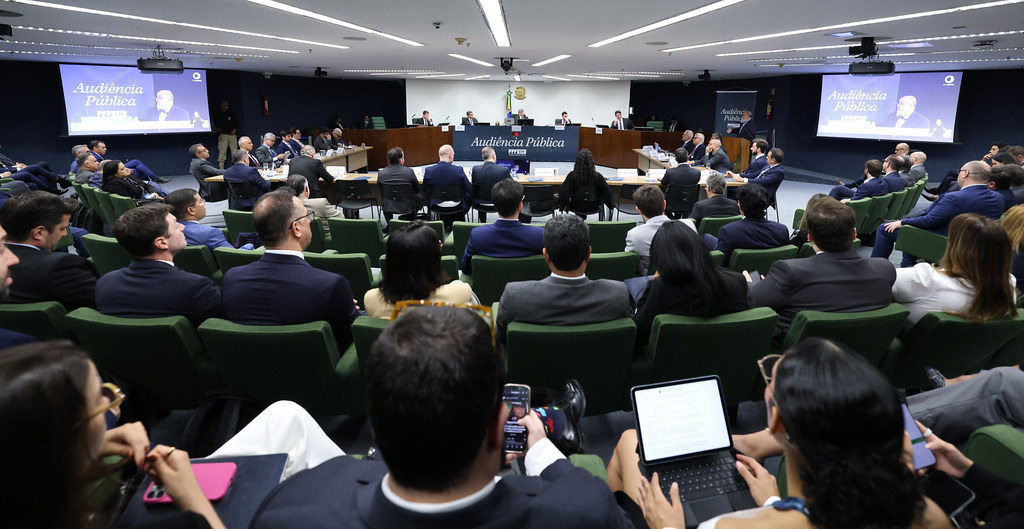
For ten hours on 3 November 2026, Brazilian football made its case in an unusual arena. Inside the Segunda Turma room of the Supreme Federal Court (STF) in Brasília, eleven clubs, the Brazilian Football Confederation (CBF), the Brazilian Olympic Committee and a long list of industry bodies queued up to explain what the country's sudden ban on betting means for the money that keeps the game running. The hearing was called by Minister Luiz Fux, rapporteur of ADI 8.027, the constitutional challenge filed by the national gaming association ANJL against Provisional Measure 1.394/2026.
The numbers put on the record were striking. According to iGaming Business, the CBF told the court that 27 of the 40 clubs in Brazil's top two divisions had a betting company as main sponsor, deals worth about BRL1bn and roughly 35% of their sponsorship revenue. The confederation also projects a BRL420m loss in competition naming rights in 2027. Flamengo alone said about BRL430m a year is at stake.
No decision was taken, and Fux will set the next steps. Yet the session offered the clearest picture so far of how deeply Sports Betting money had become woven into Brazilian football, and of what brands, operators and rights holders everywhere can learn from a market that went from full regulation to full prohibition in less than two years.
Brazil's regulated market only opened on 1 January 2025, under Law 14.790/2023. iGaming Business reported at launch that 14 companies held full licences and 52 held provisional ones, each paying a BRL30m fee for a five-year licence covering up to three brands, according to the Gambling Law Index. Operators paid 12% of gross gaming revenue, and the ANJL estimated the total effective tax burden at about 36%. By 1 July 2026 the official portal of the Secretariat of Prizes and Bets (SPA), part of the Ministry of Finance, listed 87 authorised operators.
The state did well from the arrangement. Yogonet reports that the sector generated R$9.95bn in federal taxes in 2025, plus R$4.53bn in legal levies directed to sport, public security and health. For a while Brazil looked like the textbook example of a large Latin American country moving Online Gambling from the grey market into a licensed, taxed system.
That changed on 25 September 2026, when President Lula signed Provisional Measure 1.394/2026. As summarised by Yogonet, the measure bans the operation, offer, intermediation and advertising of fixed-odds betting on real sporting events and on virtual online games, a scope that CNN Brasil notes also captures online Casino titles. New deposits and new bets were barred at once, players had until 5 October to withdraw their balances, and sites, apps and sponsorships went offline on 6 October. All authorisations ended about 30 days after publication, with no refund of licence fees and no compensation.
For marketers the most important clause was Article 16, which bans all communication, advertising, marketing and sponsorship in any medium, with existing material to be removed within ten days. In practical terms, every shirt, pitchside board and naming rights agreement involving a licensed operator lost its legal basis almost overnight.
The hearing was informational rather than decisive. STF News reports that it was requested by the Federal Attorney General's Office (AGU), which also asked for the list of speakers to grow from 26 to 34 institutions. Focus Gaming News published the running order: Flamengo, Fluminense, Botafogo SAF, Cruzeiro SAF, São Paulo, Corinthians, Ponte Preta, Vitória, Guarani, Portuguesa SAF and Grêmio for the clubs; then FENAPAF, the CBF, the Olympic and Paralympic committees, government ministries and a broad group of trade associations and universities. Each speaker had up to ten minutes, and Migalhas reports the session ran from 10:00 to 20:00.
The government side defended the measure as a public interest decision. Jorge Messias, head of the AGU, told the court, as quoted by iGaming Business, that "Recognising this effort does not oblige us to close our eyes to its limitations" and that "Reviewing a policy in light of its results is the responsibility of the State." Representatives of the Finance, Health, Justice and Sport ministries presented data on household debt, enforcement and consumer protection, while the Justice Ministry described the measure as relevant and urgent.
The industry pushed back hard. Celso Mori of the IBJR, the Brazilian Institute for Responsible Gaming, was blunt: "Now you want clandestine and irregular gambling." Yogonet quotes him adding: "I did not hear anyone here, all afternoon, say they will end illegal gambling... What I heard is that they want to end regulated gambling." The ANJL cited a 32% drop in betting volume in 2026, and the digital rights figures presented by the government, more than 36,000 illegal sites targeted for takedown between late September and late October according to STF News, underlined how large the unlicensed market remains.
Fux himself signalled where his thinking sits. STF News reports him saying there is no fundamental right to operate games of chance, while also noting at the close that some issues may be resolved outside the judiciary and that the court should act with rationality and prudence if it has to rule. Any individual decision would still need review by the full court, and Yogonet notes no deadline has been set.
The most commercially revealing part of the day came from the clubs, who used their ten minutes to put hard numbers on the record.
Flamengo vice president Flávio de Araújo Willeman said the club could lose about BRL430m a year, a figure reported by iGaming Business, Migalhas and CNN Brasil. Yogonet puts Flamengo's master sponsorship with Betano at R$268.5m a year before bonuses, or R$895m through December 2028. Willeman's plea was simple: "If there are problems with betting, let's not choose the easiest way out, which is its total repeal."
Fluminense president Mattheus Montenegro said betting accounted for 34% of the club's 2025 revenue and warned, in the words reported by iGaming Business, that the measure "eliminates the main sources of income for football." Terra and CNN Brasil report that Fluminense expects a loss of about R$200m. Migalhas adds his estimate that around R$1bn of the R$3bn in Série A commercial revenue in 2025 came from betting brands.
São Paulo said it booked about R$101m of betting-linked income between January and September, according to iGaming Business, and its Superbet agreement runs to 2030. When Yogonet Brasil reported that deal in April 2025, it valued it at R$678m in fixed payments over six years, potentially reaching R$1bn with performance targets. Corinthians, whose shirt partner Esportes da Sorte paid R$150m a year in fixed fees according to LANCE! and Inside World Football, offered the clubs as partners in the fight against addiction and illegal platforms.
Botafogo, in judicial recovery since May 2026 according to Terra, told the court that its financial plan relied on betting revenue, with its Vbet agreement the largest sponsorship in the club's history. Vitória said R$45m of its R$290m annual revenue, about 17%, comes from betting sponsorship and pitchside boards. Cruzeiro's lawyer José Francisco Manssur said the club's betting sponsorship equals four or five monthly payrolls and argued: "I believe that the solution to the problems caused by addiction and indebtedness lies in regulation and oversight."
The exposure does not stop at club level. iGaming Business reports that Betano holds the naming rights to Série A and Superbet those of Série B. Betano took the top flight rights in April 2024 on a three-year deal, which Inside World Football reported at about R$80m a season at the time. The CBF's lawyer Igor Mauler Santiago told the court the confederation expects a BRL420m loss in naming rights in 2027, and CNN Brasil reports that sponsorship talks for 2027 to 2030 have been frozen. His message was conciliatory: "CBF trusts that the three branches of government will be able to reach an appropriate and reasonable solution." Migalhas reports that he proposed a transition lasting until the 2030 World Cup.
Olympic sport is also affected. The Brazilian Olympic Committee estimated about R$130m of betting-linked money in 2027, about 20% of its planned budget, and R$325m once other sports bodies are included. "Any reduction in revenue implies readjustment or cancellation of planned projects," said COB representative Pedro Henrique Rebelo de Mendonça, quoted by iGaming Business. FENAPAF, which represents more than 88,000 professional footballers according to Migalhas, raised concerns that pushing betting offshore makes match integrity harder to monitor.
Clubs have already started improvising. Terra reports that São Paulo replaced Superbet on its shirt with Superscore, the operator's statistics platform, until the end of the year, while stressing that the underlying contract remains valid to December 2030. The club's marketing director said Flamengo, Fluminense and Palmeiras have made similar temporary arrangements. Corinthians played its match on 7 October with Jota.ai on the shirt, according to LANCE!. These moves keep logos in place, but they are not a long-term substitute for a regulated sports sponsorship relationship.
For operators, the Brazilian episode is a reminder that licence value depends on political durability as much as on tax rates. Latin Times reports that Betano held about a quarter of the regulated market, that Flutter warned the closure could cut its 2026 revenue by about $70m, and that Allwyn said its margin guidance would be unachievable if the ban lasts. Licence fees of BRL30m were paid for five-year terms that ended after less than two.
The process is far from over. According to Yogonet, the first 60-day validity period of the provisional measure expires on 23 November and extends automatically for another 60 days, which could push a congressional vote into early 2027. Meanwhile several constitutional challenges remain before the STF. At the hearing, the UERJ economic regulation laboratory proposed a middle path: a transition with milestones at 180 and 360 days, global betting limits per taxpayer, stronger self-exclusion, advertising limits and dedicated funding for prevention and treatment. iGaming Business and Migalhas both reported the proposal, which shows that a reformed regulated model is still on the table.
The wider lesson for anyone building an Online Gambling or Casino brand is that compliance cannot be treated as a one-off licence application. Responsible gambling data, advertising restraint and a credible relationship with sport and government now sit at the centre of any serious iGaming Consulting brief. Operators that can show measurable player protection have far stronger arguments when policy is reviewed.
Brazil also illustrates how Sports Betting and Casino products are increasingly judged together. The provisional measure treats fixed-odds wagers on football and online Casino games as one problem, and much of the evidence presented by the Health and Finance ministries concerned overall household spending rather than any single vertical. For multi-product operators, that means the reputation of the whole brand rides on its weakest product. Good iGaming Consulting today covers product mix, deposit limits, marketing tone and partner selection as one integrated plan, rather than leaving each to a separate team.
A further point concerns the illegal market. Ponte Preta's representative told the court, according to Migalhas, that about 61,000 suspicious sites exist, with roughly 290 new ones appearing each day. Every operator that exits a regulated market leaves space that unlicensed sites are quick to fill, which is why many regulators prefer strict licensing to outright prohibition. For iGaming Consulting teams advising on Latin America, building scenarios for both outcomes is now part of the job.
For rights holders, Brazil shows the risk of concentration. Inside World Football reports that betting accounted for 57% of Botafogo's marketing revenue and 54% of Corinthians' marketing revenue in 2025. When one category represents half of a club's commercial income, a single regulatory decision can reshape its entire budget. A balanced portfolio across banking, telecoms, aviation, real estate, technology and consumer goods offers resilience that no single category can match.
There is also an opportunity. Brazilian football remains one of the most valuable sports properties in the world, with the CBF citing R$91bn of economic activity and about 630,000 jobs in 2025, according to Migalhas. The inventory freed up by the ban, from front of shirt positions to competition naming rights, will need new partners. Brands from outside betting, including Gulf companies already familiar with global football through airlines, ports and real estate, have a rare chance to secure premium assets in one of the most passionate football markets anywhere. A structured sports sponsorship approach, with clear activation plans and exit clauses tied to regulation, will be essential.
Closer to home, the United Arab Emirates is taking a very different route, with a federal regulator, the General Commercial Gaming Regulatory Authority, licensing a tightly controlled market. For any brand weighing a marketing agency in Dubai to plan Sports Betting or gaming activity around sport, Brazil underlines why every deal needs regulatory scenario planning, morality and change of law clauses, and a communications strategy that puts consumer protection first. Online Gambling sponsorship can build huge brand awareness, but only when it rests on rules that last.
Fux now has a full record of arguments from football, Olympic sport, operators, broadcasters and government. Focus Gaming News expected him to keep the measure in force, while the clubs asked for suspension or, at minimum, a transition period that protects existing contracts. Congress must still decide whether to convert the provisional measure into law, and the full court of the STF will have the final say on its constitutionality.
Whatever the outcome, the hearing has already changed the conversation about sports betting sponsorship in Brazil. It has shown how much of the national game depended on one category, how quickly that support can vanish, and how important it is for iGaming brands to earn public trust as well as licences. For sponsors, agencies and rights holders watching from Europe, the Gulf and beyond, the message is clear: the most valuable partnerships are those built on stable regulation, transparent value and genuine benefit for fans.
Sources: iGaming Business, Yogonet, Focus Gaming News, STF News, Migalhas, CNN Brasil, Terra, Inside World Football, Latin Times, LANCE!, Gambling Law Index
We use Google Analytics cookies to see how visitors use our website. No advertising cookies. Do you accept?