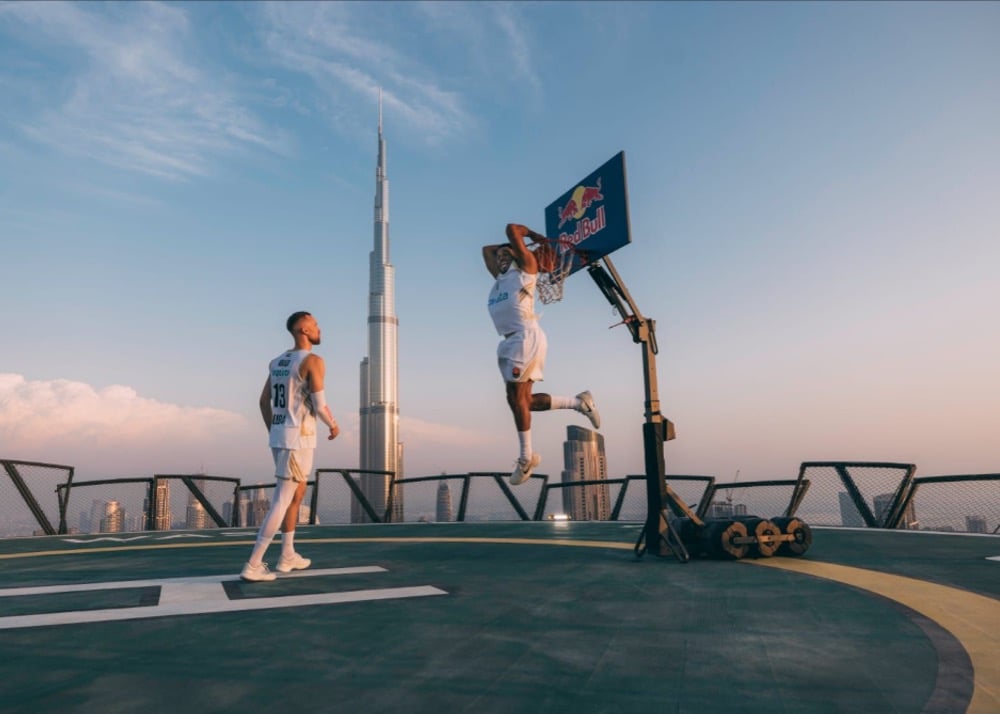
Some sponsorship announcements arrive as a press release and a handshake photo. Others are designed to be remembered. When Red Bull was unveiled as the Official Energy Drink Partner of Dubai Basketball for the 2026/27 season, the club and the brand chose the second route, staging what was billed as the world's highest altitude basketball dunk on a helipad 303 metres above the city.
The stunt took place on the helipad of Mandarin Oriental Downtown, Dubai, at Al Wasl Tower. Dubai Basketball stars Dzanan Musa and Justin Anderson combined for an alley oop, with Musa delivering the pass and Anderson finishing against the backdrop of the skyline. As Campaign Middle East reported, the moment was captured through aerial footage that moved from sunset to nightfall, and it ended with 600 illuminated drones forming the Red Bull and Dubai Basketball logos above the city.
For anyone who works in sports sponsorship in the Gulf, the deal is worth studying for more than its headline image. It shows how a young club with a fast growing international profile is building its partner roster, how a global brand with a famous content engine chooses to enter a new property, and how a single launch moment can be turned into a season of fan engagement, community work and digital storytelling.
The core of the agreement is clear. According to Gulf News, Red Bull becomes the club's Official Energy Drink Partner for the 2026/27 season. No financial terms have been disclosed, and the published coverage does not mention a contract length beyond the current campaign. What the partners have described in detail is the shape of the collaboration, and that is where the commercial story becomes interesting.
Red Bull will have a visible presence around Dubai Basketball's matchday and training environments, according to Campaign Middle East, and it will collaborate with the team on content and communications throughout the season. That combination matters. Matchday visibility gives the brand presence in front of fans in the arena and on broadcast, while access to training environments and shared content gives it something far more valuable to a media focused brand: a steady flow of authentic stories from inside a professional EuroLeague team.
The partnership also stretches beyond the arena. Both sides have announced plans to create dedicated spaces where the local community can play and connect with basketball. Education UAE noted that further details about the locations, facilities and opening dates have not yet been announced, so this element is one to watch as the season develops. Alongside the community courts, the partners will run a series of digital and fan led initiatives, giving supporters the chance to take an active role through interactive voting and content across both brands' platforms.
In other words, this is not a simple category deal in which a logo appears on a perimeter board. It is a content, community and fan engagement partnership with an official category title attached, which is exactly the model that many brands in the UAE now want when they invest in sport.
A launch event has one job: to make people talk about the partnership before the first game is played. On that measure, the helipad dunk is an example of event sponsorship thinking applied to a reveal. Rather than announcing a partner and hoping the market notices, Dubai Basketball and Red Bull created a piece of content that could travel on its own.
The concept was tightly linked to the brand. Campaign Middle East explained that the reveal brought Red Bull's signature "Giving Wings" philosophy to life, celebrating a shared commitment to pushing boundaries, supporting sporting ambition and making extraordinary moments possible. An alley oop finished hundreds of metres above the ground is a very literal expression of that idea. SportBusiness Media, which covered the launch for its Ukrainian audience, made the same point, noting that the brand tied its slogan to the high altitude alley oop. The club's own social channel joined in with a short message, "We've got wiiings!", which shows how quickly the partnership language was absorbed into the team's voice.
The setting did a lot of work too. Al Wasl Tower and the Mandarin Oriental Downtown helipad place the moment squarely in Dubai, which is important for a club whose identity is built on representing the city abroad. The drone display then turned the logos of both partners into part of the skyline. That is sports branding at its most theatrical, but it is also practical: every clip, photograph and reel from the night carries both names, and the footage can be cut into content for months.
For brands planning their own launches in the UAE, the lesson is that spectacle is most effective when it reinforces the brand promise. A stunt that could belong to any sponsor is quickly forgotten. A stunt that only makes sense for one brand becomes part of that brand's story, and of the club's.
Dubai Basketball President Dejan Kamenjašević framed the agreement around experiences and community rather than visibility alone. "Red Bull and Dubai Basketball share a belief in pushing boundaries and creating experiences that people remember," he said, as quoted by Campaign Middle East.
He added: "This partnership gives us the opportunity to bring that energy directly to our fans and the wider community, creating new ways for people to experience basketball and be part of what we are building in Dubai."
The phrase "what we are building in Dubai" is a useful reminder of where the club sits. Dubai Basketball is still a new institution, and every partnership it signs is part of a wider effort to create a basketball culture in a city that has not traditionally had a professional team in a major European competition. Campaign Middle East described the agreement as reflecting a shared ambition to fuel the next generation of basketball in Dubai, from the arena to the community. Gulf News summed up the same intent, reporting that both partners said the collaboration would focus on bringing more people into basketball.
That focus on participation is commercially sensible as well as socially positive. A sponsor that helps grow the number of people who play and follow a sport is effectively helping to grow its own future audience. For a brand like Red Bull, which has long built its marketing around active lifestyles and youth culture, community courts and grassroots activity are a natural fit.
To understand why this deal matters, it helps to look at how quickly Dubai Basketball has grown. The club was founded in 2023 and played its first ABA League game on 22 September 2024 at Coca-Cola Arena, according to the club's own announcement of its adidas partnership. That debut season ended with a run to the semi finals, as Campaign Middle East reported in 2025.
The second season brought silverware. The club's Wikipedia entry records that Dubai Basketball won the 2025/26 ABA League title against Partizan Belgrade, and that it also made its debut in the EuroLeague in 2025/26 after receiving a five year licence to take part. Gulf News described the team as representing Dubai and the UAE on the international stage, while Campaign Middle East called it the first and only sports franchise representing Dubai and the UAE in that way. With a schedule spanning both the EuroLeague and the ABA League, the club now gives partners regular exposure to European basketball audiences as well as to fans in the UAE.
The Red Bull agreement arrives, as Dubai Standard noted, as Dubai Basketball enters its third season. By this point the club already has a recognisable roster of commercial partners. In April 2025, it announced a four year partnership with adidas, making the sportswear brand its official kit sponsor until the 2027/28 season. Later that year, Campaign Middle East reported that Equiti had become the team's Founding Partner and Official Digital Wealth Partner for three seasons, with branding on jerseys and courtside at Coca-Cola Arena for all home games. The club's website also lists dnata and Mr. Eight Branded Residences among its main partners.
What emerges is a portfolio approach. Kit, financial services, aviation and travel, real estate and now an energy drink: each partner occupies a clear category, and each brings a different type of audience and activation capability. For brands considering a move into basketball in the UAE, Dubai Basketball has become one of the most visible international properties in the country, with a commercial structure that is still expanding.
This is not Red Bull's first move into UAE sport this season. In October, Gulf News reported that Red Bull and Al Ain Club had announced a new partnership, linking the brand with one of the country's most successful football clubs. Adding Dubai Basketball gives Red Bull a presence across two of the region's most followed team sports and across two emirates.
The brand also has history with basketball in Dubai. Campaign Middle East reported in January 2026 that Dubai had hosted the Red Bull Half Court World Finals in November 2025, a tournament that brought together champions from more than 30 men's and women's teams representing five continents. Aida Al Busaidy, Associate Vice President of Consumer Advocacy and Social at Dubai's Department of Economy and Tourism, said at the time: "Hosting the Red Bull Half Court World Finals directly advances the Dubai Sports Sector Strategic Plan 2033, recently launched by the Dubai Sports Council." She explained that the plan is built around the four pillars of Community, Events, Clubs and Talent, with the goal of making Dubai the leading global sporting city by 2033.
Seen in that context, the Dubai Basketball deal looks like a logical next step. Red Bull already understands the city's basketball community through grassroots events. Partnering with the city's professional team connects that grassroots activity to elite competition, and the promised community courts could become the bridge between the two. It is a joined up approach to sports marketing that many brands talk about but few execute consistently.
For other sponsors, the lesson is about coherence. A brand that appears at a grassroots event one year, sponsors a professional team the next and then funds community facilities is telling a single story about its role in a sport. Over time, that story builds brand awareness and credibility that a one off sponsorship rarely achieves.
The most instructive part of the partnership is how much of it is built around content and participation rather than static exposure. Campaign Middle East reported that fans will be able to play an active role through interactive voting and content across both brands' platforms. Gulf News added that the collaboration will extend beyond matchdays, with community basketball spaces, fan activities and digital initiatives planned throughout the season.
This reflects a wider shift in how sponsorships are valued in the Gulf. Brands increasingly want rights that let them create their own stories, publish them on their own channels and measure the response. A logo on a court is still valuable, especially when games are broadcast across Europe and the Middle East, but the real return often comes from the content that surrounds the logo. The helipad dunk is a perfect example: a single evening produced footage that the club, the brand, the hotel and the media could all share.
Interactive voting is another smart tool. It gives fans a reason to engage with the partnership repeatedly rather than once, and it gives the partners useful data about what their audiences care about. Combined with access to training environments, it allows the partners to build a season long narrative rather than a series of disconnected posts.
The community element completes the picture. Dedicated spaces where residents can play basketball would give the partnership a physical, lasting presence in the city. For a club that wants to grow the sport and a brand that wants to be associated with active lifestyles, a visible community legacy is likely to generate goodwill that paid media alone cannot buy.
For companies looking at sports sponsorship in the UAE, the Red Bull and Dubai Basketball agreement offers several practical lessons.
First, launch the partnership with intent. A carefully designed reveal can create more earned media in a day than a standard announcement achieves in a month. The best launch ideas grow out of the brand's own positioning, which is why the "Giving Wings" link made the helipad dunk so effective.
Second, buy access, not just exposure. Matchday branding is important, but rights to training environments, players and joint content are what allow a brand to tell stories throughout the season. When negotiating with a club, these rights deserve as much attention as signage and shirt positions.
Third, think about the community. Partnerships that help people play the sport build long term affinity and give sponsors a positive story to share. In a market where government strategy, such as the Dubai Sports Sector Strategic Plan 2033, places community at its centre, community activation also aligns a brand with the city's wider ambitions.
Fourth, choose properties on the way up. Dubai Basketball has moved from its first game in 2024 to a regional title and a place in the EuroLeague in a very short time. Brands that join a rising property early often secure better positioning and more creative freedom than those that arrive once the roster of partners is full.
Finally, connect every element. The strongest sponsorships link the launch, the matchday presence, the digital programme and the community legacy into one story. That is where specialist sports marketing support adds value, from identifying the right property and negotiating rights to planning activation and measuring results. Brands that want to extend that story across broadcast and social channels can also build a wider 360 marketing plan around the partnership, so that every piece of content works harder.
The 2026/27 season will show how far the Red Bull partnership can go. The headline moment has already been delivered, and the next tests will be the community courts, the fan voting programme and the content produced from inside the team. If the partners deliver on what they have announced, the deal could become a reference point for how energy, lifestyle and consumer brands activate around professional sport in the Emirates.
It also confirms Dubai Basketball's position as one of the most commercially active sports properties in the region. A club that only played its first official game in 2024 now counts adidas, Equiti, dnata, Mr. Eight Branded Residences and Red Bull among its partners, and it competes against Europe's best every week. For a city that wants to be the leading global sporting destination by 2033, that is a powerful signal.
For brands, the message is simple. Sport in the UAE is no longer only about hosting major international events. It is increasingly about long term partnerships with local teams that have real fans, real stories and genuine ambition. Working with a marketing agency in Dubai that understands both the commercial and the cultural side of these properties can help a brand find its own version of the helipad moment, and then turn it into a full season of brand awareness and fan connection.
Sources: Gulf News, Campaign Middle East, Education UAE, Dubai Standard, SportBusiness Media, Dubai Basketball, Wikipedia
We use Google Analytics cookies to see how visitors use our website. No advertising cookies. Do you accept?